Showing posts with label Architecture. Show all posts

Saturday, February 21, 2015

Maya Mural Reveals Ancient 'Photobomb'

A man with the title "junior obsidian" kneels before the king
in a Maya mural researchers uncovered in Guatemala in 2010.
Credit: Illustration by Heather Hurst, copyright 2014
Live Science | Feb 20, 2015 | Laura Geggel

An ancient Maya mural found in the Guatemalan rainforest may depict a group portrait of advisers to the Maya royalty, a new study finds.

Most Maya murals depict life within the royal sphere, but the newfound mural, uncovered in the Guatemalan rainforest in 2010, shows a vibrant scene of intellectuals consulting with the royal governor, who is dressed as the Maya wind god.

Behind him, an attendant, almost hidden behind the king's massive headdress, adds a unique photobomb to the mural, said Bill Saturno, the study's lead researcher and an assistant professor of archaeology at Boston University. [See Photos of the Ancient Maya Mural]

The murals also provide information about a man buried beneath them. During an excavation, the archaeologists found the skeleton of a man dressed like the sages in the mural. It's possible the man once lived in the room, which later became his final resting place, Saturno said.

Archaeologists discovered the approximately 1,250-year-old mural in the ancient city of Xultun, located in the northeastern part of present-day Guatemala. During an archaeological study of Xultun, an undergraduate student inspecting an old looters' trail noticed traces of paint on an ancient wall covered by dirt.

"My assumption was that there would be very little to see," Saturno said. "Not because the Maya didn't paint murals — they did — but they don't preserve well in a tropical environment."

However, the elements had been kind to the building and its treasures. The excavation uncovered a rectangular room covered with murals and a Maya calendar, the oldest known Maya dating system on record.

Mysterious obsidians

The mural is one of only two known murals in the eastern Maya lowlands that have lasted throughout the ages, the researchers said. The Xultun paintings, illustrated in vibrant red, blue, green and black pigments, cover three of the room's four walls. The fourth wall, damaged by looters, contains the door.

Saturno and his colleagues excavated past the point where the looters tunneled, and came face-to-face with "the polychrome face of a king seated with his blue-feathered headdress," Saturno said. A man kneeling before the king, labeled itz'in taaj, or "junior obsidian," faces the king in profile.

ch'ok, or "youth," and another is called sakun taaj, or "senior obsidian."

This illustration shows a view of the northern
and western walls in the Xultun mural chamber.
Credit: Illustration by Heather Hurst, copyright 2014
Behind the junior obsidian, on the west wall, are three men dressed in black and sitting cross-legged. One of the men is labeled

It's unclear what "obsidian" means, the researchers said.

"Are they religious? Are they scholars? Is there a line between those things?" Saturno said. "They seem to be making books and painting tables on the walls."

All three men wear the same headdress with a medallion and feathery plume, a white loincloth and a medallion on their chests.

"You see these three guys dressed identically and lining up on one wall," Saturno said. "That's strange. They're clearly being represented as a unit."

The fact that they're all wearing the same uniform suggests the obsidians shared similar duties, Saturno said. Moreover, the people who filled the obsidian order probably lived in the room for a period of time, as there are dozens of texts painted on the walls. [Maya Murals: Stunning Images of King & Calendar]

Water and tree roots largely damaged the east wall, but the archaeologists still managed to find the painted remains of three individuals.

All the king's men

The mural may depict a consultation between the king and the obsidian, the researchers said. The king is dressed as a version of the wind god, holding a staff with wind symbols on it.

"Maya kings often dress up as deities in performance," Saturno said. "Essentially re-enacting events from the mythic past."

The timing of the performance was important, and the obsidian may have been advising the king about its correct date, he said. To remember meetings such as these, obsidians or artists may have painted the mural, he said.

"The mural establishes a direct relationship between a particular order, or guild, of Xultun artists and scribal-priests and their lord, and it celebrates its members’ achievement in consulting and producing work for their sovereign's reign," the researchers wrote in the study.

The king sports blue, green and orange accessories, whereas the obsidians are painted in reddish and black colors. The pigments from the king's portrait "are not common to that part of the region where it's from," Saturno said. "These are materials that are being traded in."

The painting also shows an attendant behind the king, possibly to hold up his headdress, Saturno said. "It's like a photobomb," he joked. "He's almost like, 'Do you see me here?'"

In contrast, the orange and red colors are made from local pigments, which likely helped differentiate between royal and non-royal subjects in the mural, the researchers said.

The study is "a brilliant gem of scholarship," said David Freidel, a professor of anthropology at Washington University in St. Louis, who was not involved with the study.

"This room celebrates a special group of members of the royal court of Xultun that are called obsidian, [or] taaj," Freidel said. "The obsidian people appear to be present at other sites, but we don't know much about them."

It's remarkable that the intricate mural wasn't painted at the royal residence, said Takeshi Inomata, a professor of anthropology at the University of Arizona, who wasn't involved in the study.

"This comes from the residence of a courtier, a court official," Inomata said. "This tells us about how those political organizations of Maya society were run, and then we can really get to the people who are really doing all of those things."

The study was published in the February issue of the journal Antiquity. The coauthors are Heather Hurst at Skidmore College in New York, Franco Rossi at Boston University and David Stuart at the University of Texas at Austin.

Follow Laura Geggel on Twitter @LauraGeggel. Follow Live Science @livescience, Facebook & Google+. Original article on Live Science.

Wednesday, February 11, 2015

A World Gone Mad: Little Boxes on the Hillside… And We’re All the Same

TruthStream Media | Feb 11, 2015 | Aaron Dykes and Melissa Melton


We have indeed been reduced to mere cogs in the machines… look around us at the automated, redundant, cliche, monotonous and generic society that has been built up around us. Conformity becomes us.


No one is saying that your home and your things define you, but just why exactly are they ALL virtually the exact same? Just little cookie cutter houses. Everyone’s “just doin’ their job.” All the smart devices are just spying. The subtle tyranny creeps in.

Mind control in its blandest form, creating predictable, simple people, with simple problems, too trapped in a maze of sameness to ever look upwards or outwards, too concentrated on the tiny problems of fitting in and making it up the corporate ladder to do much questioning of the system. Too worried about keeping up with the Jones’ to question why we’re here, what it means, and why things ended up this way.

A subtle, but horrible conspiracy of conformity, a brutal chilling of dissent by efficient copy & pasted lifestyles dictated by those steering the market from Wall Street and beyond.

“The conscious and intelligent manipulation of the organized habits and opinions of the masses is an important element in democratic society. Those who manipulate this unseen mechanism of society constitute an invisible government which is the true ruling power of our country. We are governed, our minds are molded, our tastes formed, our ideas suggested, largely by men we have never heard of.” – Edward Bernays, Propaganda (1929)


Read these lyrics from Malvina Reynolds:
Little boxes on the hillside,
Little boxes made of ticky tacky,
Little boxes on the hillside,
Little boxes all the same.
There’s a green one and a pink one
And a blue one and a yellow one,
And they’re all made out of ticky tacky
And they all look just the same.
And the people in the houses
All went to the university,
Where they were put in boxes
And they came out all the same,
And there’s doctors and lawyers,
And business executives,
And they’re all made out of ticky tacky
And they all look just the same.
And they all play on the golf course
And drink their martinis dry,
And they all have pretty children
And the children go to school,
And the children go to summer camp
And then to the university,
Where they are put in boxes
And they come out all the same.
And the boys go into business
And marry and raise a family
In boxes made of ticky tacky
And they all look just the same.
There’s a green one and a pink one
And a blue one and a yellow one,
And they’re all made out of ticky tacky
And they all look just the same.
 

Friday, February 6, 2015

One in TEN Cell Phone Antenna Sites Violates Gov’t Limit on Excessive EMF Radiation

TruthStream Media | Feb 5, 2015 | Melissa Melton

image
Did you know there are over 2.3 million cell towers and antennas blanketing the United States right now?

That’s a lot of electromagnetic frequency right there.

While some people, including myself, have pointed out that it’s ridiculous to find a giant cell tower erected literally on an elementary school basketball court right next to the playground or placing them directly on school rooftops, this is becoming more and more common to the point there are so many towers and antennas everywhere, they are beginning to blend in with the scenery as if having this many of these things is just natural now.

Pretty soon, no matter where you go in this country, you’ll be within mere feet of at least one cell tower or antenna (but likely many more).

Well, according to the Wall Street Journal, a team of six engineers evaluated more than 5,000 of these cites and found that one in ten is violating the rules on excessive radiation.

Federal rules require carriers to use barricades, signs and training to protect people from excessive radio-frequency radiation, the waves of electric and magnetic power that carry signals. The power isn’t considered harmful by the time it reaches the street, but it can be a risk for workers and residents standing directly in front of an antenna.

One in 10 sites violates the rules, according to six engineers who examined more than 5,000 sites during safety audits for carriers and local municipalities, underscoring a safety lapse in the network that makes cellphones hum, at a time when the health effects of antennas are being debated world-wide.

Putting aside the argument about what megacorporations that want to sell you stuff will tell you is and isn’t harmful, this is insane.

We are all being exposed to this more and more every day.

Oh, and apparently the Federal Communications Commission (FCC) has only issued TWO — that’s two — citations to cell carriers since adopting these limits nearly twenty years ago way back in 1996.

Why? Because, “the FCC says it lacks resources to monitor each antenna.”

This, engineer Marvin Wessel told WSJ, is like having speed limit signs but no police to enforce them… meaning it’s POINTLESS to even have radiation limits if no one is monitoring that these companies are adhering to them. The whole set up requires an awful lot of trust in communications companies who have already demonstrated through Snowden leaks that they don’t really care about their customers’ rights at all.

So the FCC doesn’t have the proper resources to actually hold cell phone companies accountable if their towers and antennas are emitting harmful radiation levels well above federal limits, but said companies are allowed to just continue to blanket our nation with them at an alarming pace anyway???

Makes sense, right?

Used to be antennas were only on towers that are easily visually recognizable. Nowadays these antennas can be hidden, painted to blend into the background and people might not even realize they’re hanging out near one. This is what Wessel is talking about, again via WSJ:

On a sweltering June day in Phoenix, Mr. Wessel strolled through a residential area near Echo Canyon Park and spotted lawn chairs near a T-Mobile US Inc. cellular antenna painted brown to match a fence. His monitor showed emissions well above safety limits.

After being alerted by The Wall Street Journal, T-Mobile added warning signs and roped off a patch in front of the antenna with a chain. “The safety of the public, our customers and our employees is a responsibility that all of us here at T-Mobile take very seriously,” said a T-Mobile spokeswoman.

So why is this an issue?

At very high levels, radio-frequency radiation can cook human tissue, the FCC said, potentially causing cataracts and temporary sterility and other health issues.

To buffer people from these “thermal” effects, the FCC set two limits for how much RF people can absorb—one for the general public, and an “occupational” limit five times higher for people trained to work near antennas. The higher level is still 10 times below the thermal level.

Carriers have to restrict access near antennas that are above the limits. Workers and others who venture into hot zones—generally up to 20 feet in front of an antenna—must be trained and have RF monitors.

Realize this man said one in TEN of these locations is OUT OF COMPLIANCE regard to EMF radiation, emitting levels well beyond FCC limits for public safety and health.

Now back to the fact that we have over 2.3 million of these all over the country and counting…

Your body also has electromagnetic fields, but somehow we’re supposed to believe these artificial EMF emitters surrounding us aren’t affecting us every single day and somehow disturbing the growth of cells and the flow of information between our cells?

The BioInitiative Working Group put out a report in 2007 which concluded the existing public safety standards are inadequate anyway. Evidence has shown EMF:
  • Affects gene and protein expression (Transcriptomic and Proteomic Research)
  • Has genotoxic effects – RFR and ELF DNA damage
  • Induces stress response (Stress Proteins)
  • Affects immune function
  • Affects Neurology and behavior
  • Causes childhood cancers (Leukemia)
  • Impacts melatonin production
  • Promotes breast cancer (Melatonin links in laboratory and cell studies)
  • Contributes to Alzheimer’s Disease
Other studies link EMFs to:
  • Enzyme changes that affect DNA and cell growth which can result in cancer and birth defects
  • Fetal abnormalities, likely caused by enzyme changes
  • Gene expression changes, which creates stress on your body and even result in cancer
  • Changed metabolism and increased cell growth
  • Increased production of stress proteins within cells
  • Chronic stress, which can lead to heart conditions among others
  • Neuro-hormone changes, which can result in memory loss and impaired brain function
The bottom line?

We are basically living in an open air science experiment on so many fronts in this country and cell phone towers are definitely one of them. We have no idea how this is going to look even a decade or two from now, especially for the poor people who work for cell phone companies who are coming into direct, close contact with these things on a daily basis.

If you live in an urban, suburban or even semi-rural area, you will probably be pretty surprised at just how many towers and antenna are humming all around you right now. They are installing towers and antennas on school rooftops, in church steeples, on our municipal water towers, and in everything from fake trees to fake cement blocks on buildings that are meant to blend in with the rest of the building materials. They are no longer as obvious as they used to be, and thus, no longer as easy to avoid.

Do a search for your address at Antenna Search.com. You might be surprised how many of these things live near you.

Originally posted at The Daily Sheeple

Saturday, December 27, 2014

Quantum Physics and Romanesque Art - Lothar Schäfer, Ph.D.

scienceandnonduality | Dec 26, 2014

Deep Truths Are Eternal. They constantly return and engage the Human Mind. The discovery of Quantum Physics that there is an invisible part of the world, which doesn't consist of things, but of non-material forms, is such a truth. We find it, for example, in the work of the European Romanesque Artists, between 1000 – 1120 CE. the artists at that time believed that the basis of reality is an invisible mystery, and they wanted to reveal that mystery in their art. In this lecture the parallels between the world view of Quantum Physics and that of the Romanesque Artists will be described, which suggest that our mind is connected with a Cosmic Mind, which expresses its principles as thoughts in our mind and as material structures in the external world.

Lothar Schäfer is Distinguished Professor (emeritus) of Physical Chemistry at the University of Arkansas. His research in physical chemistry, electron diffraction, applied quantum chemistry, and computational chemistry led to developing the first real-time gas electron diffraction instrument in which data is recorded online, enabling the first pulsed-beam, timeresolved studies of laser-excited molecules, and to performing the first quantum chemical geometry determinations of peptide molecules, predicting structural trends in proteins a decade before experimental observation. Author of Infinite Potential and In Search of Divine Reality.

Monday, September 29, 2014

Massive 5000 Year Old Stone Monument Discovered


Collective Evolution | Sep 26, 2014 | Arjun Walia

Imagine missing something this big for so long. It makes one wonder, what else has archaeology missed? Has all that’s been discovered so far been revealed to the public? What else remains undiscovered? One who has peered into the world of secrecy would be inclined to think, ‘probably not.’ After all, there is sufficient evidence to suggest that the United States alone spends trillions of dollars on ‘black budget’ programs that go beyond government, have no oversight from congress and involve projects that the human race knows nothing about. You can read more about that here.

A lunar crescent shaped stone monument has recently been discovered in Israel. It dates back approximately 5000 years, between 3050 B.C. and 2650 B.C., which means it is most likely older than the pyramids of Egypt, and built before the Stonehenge was constructed.

It’s located approximately 8 miles northwest of the Sea of Galilee, and is massive. It measures approximately 14,000 meters, which is about 500,000 cubic feet.

Ido Wachtel, a Doctoral student at the Hebrew University of Jerusalem said:
“The proposed interpretation for the site is that it constituted a prominent landmark in its natural landscape, serving to mark possession and to assert authority and rights over natural resources  by a local rural or pastoral population.” (source)
Again ,the structure is about 150 meters (492 feet) long and 20 m (66 feet) wide at its base. According to Wachtel:
“The estimation of working days invested in the construction [of] the site is between 35,000 days in the lower estimate [and] 50,000 in the higher.” (source)
It’s remarkable how much time was put into constructing various magnificent structures that even to this day, have construction methods that cannot be explained. Theories have ranged from advanced extraterrestrial races to massive amounts of man and brain power.

For example, most Egyptologists estimate between 2.3 and 2.6 million blocks of stone were used to build the great pyramid. What power could have moved these stones? Each stone has been estimated to weigh approximately between 2 and 20 tonnes each. Think about that, that’s 2.5 million blocks of stone that weigh between 2 and 20 tonnes each. How did they cut the blocks with laser like precision and fit them perfectly in place? How did they lift and transport the rocks from their original position? How did they move across the terrain, dessert, water and sand and then lift them on top of each other in order to build the pyramid?

Perhaps one of the greatest mysteries is the fact that the Great Pyramid is positioned exactly at the latitude and longitude lines that contain more land and less sea than any other place on Earth. It’s right in the ‘geographical’ center of the Earth. This fact alone (out of many) suggests that the builders also knew a great deal about the geography of our planet. It’s hard to imagine they could complete all of this without some sort of aerial view. Don’t forget about the Orion mystery. How this knowledge was obtained remains a mystery. Think about it, how is this possible?

You can read more about the many mysteries regarding the great pyramids in Egypt HERE.

Although this monument in Israel is not as complex (low estimates are a team of 200 ancient workers would have needed more than five months to construct the monument) it’s still a task that would be difficult for people who depended on crops for their livelihood.

According to Live Science:
“Other large rock structures have been found not far from the crescent-shaped monument. One structure, called Rujum el-Hiri, isin the Golan Heights (an area to the east of the Sea of Galilee) and has four circles with a cairn at its center. The date of this structure is a matter of debate; recent research by Mike Freikman, an archaeologist with the Hebrew University of Jerusalem, suggests it may predate the crescent-shaped structure by several centuries.

Another stone monument, a giant cairn that weighs more than 60,000 tons, was discovered recently beneath the waters of the Sea of Galilee. Its date is unknown, but like the crescent-shaped structure, it is located close to Bet Yerah.”
I found this to be pretty cool:

The moon god Sin (also called Nanna and Suen) may be the key to understanding the monument. A lunar crescent served as his symbol and the name of Bet Yerah suggests that he may have been revered there. This image shows an ancient seal (from another site) mentioning him with the lunar crescent engraved on it.

Our ancient worlds continue to be a mystery, but there is a lot of evidence to suggest that they were far more advanced than we were, and that they might have had some help.

Sources:

Saturday, July 5, 2014

Apollo astronaut says: Man-made global warming hypothesis is the 'biggest fraud in the field of science'

© NASA
Astronaut Walter Cunningham
in the Apollo era.
Sott.net | Jul 2, 2014 | Craig Bannister

Climate alarmism is "the biggest fraud in the field of science" and the 97% consensus claim is nonsensical, Apollo 7 astronaut Walter Cunningham tells MRCTV in a preview of his presentation at the upcoming Heartland Institute climate conference, July 7-9.

"Since about 2000, I looked farther and farther into it," Col. Cunningham (USMC, Ret.) tells MRCTV in an exclusive interview. "I found that not one of the claims that the alarmists were making out there had any bearings, whatsoever. And, so, it was kind of a no-brainer to come to the conclusion."

 Cunningham rejects the notion of man-made climate, not only as fact - but also as even qualifying as an actual "theory":

"In the media, it was being called a theory. Obviously, they didn't know what it means to be a theory."

"If we go back to the warmist hypothesis - not a theory, but, a hypothesis- they've been saying from the very beginning that carbon dioxide levels are abnormally high, that higher levels of carbon dioxide are bad for humans, and they thought warmer temperatures are bad for our world, and they thought we were able to override natural forces to control the earth's temperature. So, as I've looked into those, that's the problem that I've found, because I didn't find any of those to be correct - and, they certainly were not a theory, it was just their guess at what they wanted to see in the data they were looking at."

Cunningham urges Americans to look at the data and decide for themselves, instead of taking anyone else's word for it:

"You go out and take a look at it and you find out that a lot of it is pure nonsense and wishful thinking on the part of the alarmists who are looking for more and more money to fall into their hands."

Read more..

Saturday, May 31, 2014

West Texas rapidly running out of water - less than 90-day supply remaining in dozens of towns

 © Natural News
Natural News | May 30, 2014 | Julie Wilson

At least 33 communities in Texas could soon be completely out of water, some within three short months. Others say they could go dry in just 45 days.

Pebble Beach, a town northwest of San Antonio, has had their request approved for a $350,000 grant from the U.S. Department of Agriculture to dig new, deeper wells.

Bandera County, an area located on the Edwards Plateau, said they intend to match $90,000 in order to acquire property so they can build a 30,000-gal. ground storage tank for the community.

Resident Joe Mooneyham told KHOU-TV that he hasn't been able to water his lawn since last September.

"Everything was just emerald green," said Mooneyham. He told the local news that he misses the green landscape, deer and the normal water levels that once existed in Lake Medina. The lake behind the Pebble Beach resident's home has receded more than one and a quarter mile away.

"Every day I go on and check the level," Mooneyham said.

Pebble Beach is named as such because of a field of small stones covering a nearly dried up lakebed. Neighbors just a few miles down the road are purchasing tens of thousands of dollars worth of water and having it shipped in just to survive. Unfortunately, communities are routinely being developed in areas lacking the water needed to support them. Existing communities nearby then have their water resources dried up attempting to support the new developments.

Often, the developer gets in, builds and gets out, leaving residents to face water shortages.

The Environmental Protection Agency (EPA) monitors towns like Pebble Beach for water shortages but has failed to enforce necessary regulation on developers building in areas with unsustainable water resources.

"The well-service people have been lowering pumps. Some have had to have new wells drilled. It's just a fact of nature," said Bandera County Judge Richard Evans.

Pebble Beach only has one well, said Judge Evans. "They need another well. They need storage capacity. So, that's what we're trying to help them effect."

St. Mary's University water law professor Amy Hardberger weighed in, saying, "We have sort of taken water for granted for a long time. And I think that time is over. I think its valuation has gone up. Some communities are in more trouble than others."

Desperate for rain


Texas was hit hard with a drought three years ago, leaving many regions still unable to recover. More than two-thirds of the state suffers from moderate to severe drought conditions.

Lake Travis provides water for more than 1 million people throughout the Austin area. Officials with the Lower Colorado River Authority (LCRA) say prolonged drought is the cause of extremely low water levels, which are still about 50 ft. below average.

Repeated, heavy rainstorms are required to "significantly raise storage levels," said the LCRA's website. The LCRA is primarily reliant on water flow from the Colorado River to supply demand for cities, power plants, farming and environmental flow requirements.

While many Texas regions have been affected by droughts, counties in the North and Northwest have suffered the most, with areas listed as a #4 for Exceptional Drought on the intensity scale.

As of May 21, statistics provided by the Texas Commission on Environmental Quality (TCEQ) indicate that there are 12 public water systems that could run out of water in 45 days, and 21 that could run out in 90.

Residents of Wichita Falls came up with a new way to deal with water shortages last month when they proposed to recycle toilet bowl water, reported National Public Radio. TCEQ officials are required to conduct testing of the recycled wastewater before approving the $13 million proposal.

The city is expecting an answer by the end of May.

Additional sources:

http://www.chron.com

http://www.npr.org

http://www.tceq.texas.gov

http://hydromet.lcra.org

http://travis.uslakes.info

http://www.khou.com

Thursday, May 29, 2014

Why Would You Want To Spy On Yourself For The Government?

© Alt-Market
Alt-Market | May 28, 2014 | Melissa Melton

And alternately, how “smart” do you really want your home to be?

The commercials have been airing for awhile now: you can protect your home with a smart CCTV camera system that includes full streaming, night vision, two-way talk back, and digital zoom for only $150. You can even add on the optional cloud recording to access stored footage of your home for up to a month (all encrypted for your security, of course).

Now news has surfaced that Google’s “Nest” division, which involves smart thermostats that program themselves and can be remotely controlled to change your home’s temperature over the Internet from anywhere, is looking to move into home security with plans to purchase home CCTV system-maker Dropcam.
“With a Dropcam Wi-Fi video monitoring camera and optional cloud recording service you can remotely drop in on your house, baby, pets, business, or anything else from a smartphone, tablet, or computer,” the firm says. (source)
Check out the video. Dropcam’s CEO says they built it to answer a really simple question: “What goes on at home when I’m not there?”

Guess it depends who is asking the question. Google’s plans ultimately involve, according to Mail Online, total home automation.

Apparently this comes just as Apple is planning to unveil its own home automation app that would tie everything together:
An Apple patent published in November last year gave the first hints of the system, showing a system that automatically turned on lights when a user comes home.
It is believed the firm is already working with home automation firms to ensure their gadgets work with the app.
The firm already sells home automation gadgets in its stores, including including arch rival Google’s Nest thermostats, Dropcam wireless cameras, Philips Hue lightbulbs and Belkin WeMo switches. [SIC] (source)
That means you and your house will be constantly creating bits of data that form a blueprint of your daily life: how much electricity and water you use and when you use it, on top of a camera that video tapes you using it.

And what of privacy?

And if you can “drop in” on your house, you have to wonder, who else can drop in, too?

After all, it was just last month that a hacker tapped into a couple’s app-controlled baby monitor, and they awoke to a strange man operating the camera and screaming at their baby in the middle of the night from inside their home.

Beyond that, we live in a world where the so-called National Security Agency’s habit of spying on Americans through major telecommunications companies like Google and Apple has been fully exposed now. It’s not even a question of if they do it anymore. They are openly doing it. Period.

Why else would they need to build a $3 billion data hub in the Utah desert?

(On a side note, it’s pretty interesting that out of three American cities that Google chose to first launch it’s Fiber super high speed internet, one of them is Provo, Utah…a choice that hardly makes sense in lieu of larger cities until you consider Provo is just 30 minutes away from the aforementioned NSA spy hub.)
In addition to apps that track your house, Apple is also set to unveil an app that tracks…you:
Called Healthbook, the new app is expected to be unveiled in June at Apple’s annual developer conference. It offers everything from food and sleep tracking to blood sugar level analysis – and can even tell how much water you’ve drunk. (source)
Check out the control panel that comes with your trendy new “health-tracking wristband” iWatch:

We now live in such a fear-based technocratic society, we are literally paying to give up liberty for security.

Pretty soon, your smart phone/smart pad/smart watch/computer (and anyone with access to it) will know everything about you, your home, your habits, and basically your whole entire life. The concept of privacy is quickly going out the virtual window.

The human race is about to get sucked up into the Internet of Things — “a global, immersive, invisible, ambient networked computing environment built through the continued proliferation of smart sensors, cameras, software, databases, and massive data centers in a world-spanning information fabric.”

Are you ready?

 This article was written by Melissa Melton and originally published at The Daily Sheeple

Friday, May 2, 2014

Solved! How Ancient Egyptians Moved Massive Pyramid Stones

The Pyramids of Giza, built between 2589 and 2504 BC.
Credit: Dan Breckwoldt | Shutterstock
Live Science | May 1, 2014 | Denise Chow


The ancient Egyptians who built the pyramids may have been able to move massive stone blocks across the desert by wetting the sand in front of a contraption built to pull the heavy objects, according to a new study.

Physicists at the University of Amsterdam investigated the forces needed to pull weighty objects on a giant sled over desert sand, and discovered that dampening the sand in front of the primitive device reduces friction on the sled, making it easier to operate. The findings help answer one of the most enduring historical mysteries: how the Egyptians were able to accomplish the seemingly impossible task of constructing the famous pyramids.

To make their discovery, the researchers picked up on clues from the ancient Egyptians themselves. A wall painting discovered in the ancient tomb of Djehutihotep, which dates back to about 1900 B.C., depicts 172 men hauling an immense statue using ropes attached to a sledge. In the drawing, a person can be seen standing on the front of the sledge, pouring water over the sand, said study lead author Daniel Bonn, a physics professor at the University of Amsterdam. [Photos: Amazing Discoveries at Egypt's Giza Pyramids]

"Egyptologists thought it was a purely ceremonial act," Bonn told Live Science. "The question was: Why did they do it?"

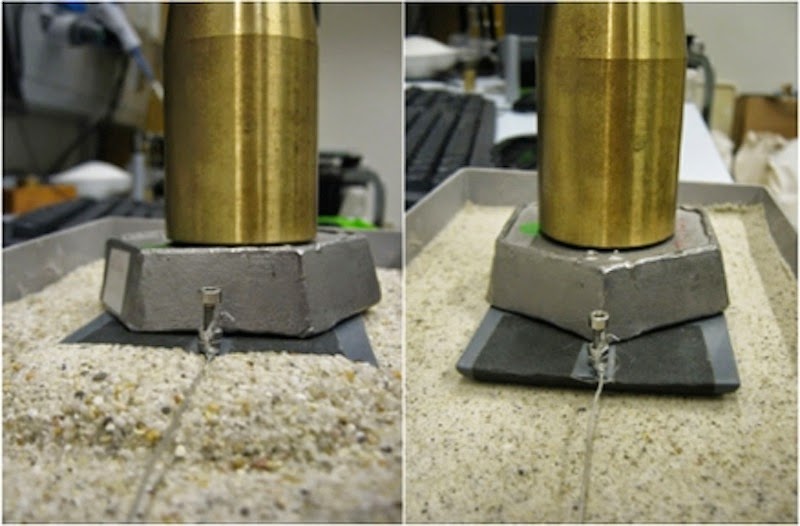
Bonn and his colleagues constructed miniature sleds and experimented with pulling heavy objects through trays of sand.

When the researchers dragged the sleds over dry sand, they noticed clumps would build up in front of the contraptions, requiring more force to pull them across.

Adding water to the sand, however, increased its stiffness, and the sleds were able to glide more easily across the surface. This is because droplets of water create bridges between the grains of sand, which helps them stick together, the scientists said. It is also the same reason why using wet sand to build a sandcastle is easier than using dry sand, Bonn said.

A large pile of sand accumulates in front of the
sled when it is pulled over dry sand (left).
On the wet sand (right) this does not happen.
Credit: Daniel Bonn/University of Amsterdam
But, there is a delicate balance, the researchers found.

"If you use dry sand, it won't work as well, but if the sand is too wet, it won't work either," Bonn said. "There's an optimum stiffness."

The amount of water necessary depends on the type of sand, he added, but typically the optimal amount falls between 2 percent and 5 percent of the volume of sand.

"It turns out that wetting Egyptian desert sand can reduce the friction by quite a bit, which implies you need only half of the people to pull a sledge on wet sand, compared to dry sand," Bonn said.

The study, published April 29 in the journal Physical Review Letters, may explain how the ancient Egyptians constructed the pyramids, but the research also has modern-day applications, the scientists said. The findings could help researchers understand the behavior of other granular materials, such as asphalt, concrete or coal, which could lead to more efficient ways to transport these resources.

Follow Denise Chow on Twitter @denisechow. Follow Live Science @livescience, Facebook & Google+. Original article on Live Science.

Wednesday, April 30, 2014

Ancient Civilizations? Check Out These Mysterious Structures Found On The Bottom Of The Ocean Floor


The Truth Wins | Apr 28, 2014 | Michael Snyder

In cultures all over the world, there are ancient stories about beautiful, prosperous cities that became submerged in the ocean and were never seen again.  The most famous of these is the story of Atlantis, but there are many others.  So could it be possible that some of these cities actually exist?  In recent years, modern technology has allowed humanity to investigate the ocean floor like never before.  As we have done so, we have made some incredible discoveries.  You are about to see some amazing mysterious structures that have been found on the bottom of the ocean floor all over the world.  Could these mysterious structures actually be evidence of very advanced ancient civilizations?  As we learn about these ancient civilizations, will this knowledge turn the conventional version of human history that we all learned in school upside down?

We live at a time when mind blowing discoveries are being made at a pace never seen before.  Just last month, I wrote about the megalithic ruins that have just been discovered in Russia that contain the largest blocks of stone ever found (even bigger than Baalbek).

Nobody can explain where those stones came from, who lived there, or how ancient humans could cut and move such massive blocks.

Well, similar things could be said about many of these mysterious structures on the bottom of the ocean floor…

The Ancient Underwater City Of Yonaguni-Jima, Japan
For as long as anyone can remember, residents of Okinawa have passed on stories of a vast underwater city to their children.  Most considered those stories to simply be myths.  But after what happened in 1986, that all changed…
In 1986, a diver near the island of Yonaguni Jima, off the southern tip of Japan (around Okinawa) came across some strange structures about 25 metres below sea level.
They appeared to be stepped structures with terraces and ramps.

One of the largest pyramid structures is 600 feet wide and 90 feet high –with five separate levels of stone blocks with what appears to be road surrounding the structure.

Tool marks and carvings have been discovered upon the stones (and documented) which indicate that they have were constructed rather than being natural stone structures.

Masaaki Kimura, a marine geologist from Japan’s Ryukyus University, Japan has been studying and mapping the site for over 15 years and believes that the site is over five thousand years old – but was sunk during an earthquake two thousand years ago.
I have posted a YouTube video about these incredible ruins below.  As you can see, they truly are remarkable…


Dwarka – Off The Coast Of India
An incredible underwater city can be found just off the coast of India as well.  It is known as “Dwarka”, and at the longest point it stretches for five miles.  Once again, this city provides evidence of a highly advanced civilization in the ancient world…
The Bay of Cambay was discovered by marine scientists in early 2002. The city is located 120 feet underwater in the Gulf of Cambay off the western coast of India. The city is five miles long and two miles wide, carbon dating estimates the site to be a whopping 9,500 years old, and, more amazingly, architectural and human remains are still intact. The discovery astounded scientists because it predates all other finds in the area by 5,000 years, suggesting a much longer history of the civilization than was first assumed. Marine scientists used sonar images and sum-bottom profiling to locate the lost ruins and it is believed the area was submerged when the ice caps melted in the last Ice Age. The Indian nationals have dubbed the find ‘Dwarka’ (The Golden City) in honor of ancient submerged city said to belong to Hindu god, Krishna.
In the YouTube video posted below, you can learn much more about Dwarka…


Cuban Underwater City

In 2001, the BBC reported on the discovery of a “lost city” in Cuban waters…
A team of explorers working off the western coast of Cuba say they have discovered what they think are the ruins of a submerged city built thousands of years ago.
Researchers from a Canadian company used sophisticated sonar equipment to find and film stone structures more than 2,000 feet (650 metres) below the sea’s surface.
Some have speculated that this could be the location of the mythical city of Atlantis, but since 2001 follow up work has been slow.  The following is what Wikipedia has to say about this “lost city”…
Cuban underwater city refers to a site thought by some to be a submerged granite complex structures off the coast of the Guanahacabibes peninsula in the Pinar del Río Province of Cuba.
Sonar images interpreted as being symmetrical and geometric stone structures resembling an urban complex were first recorded in early 2001 covering an area of 2 square kilometres (200 ha) at depths of between 600 metres (2,000 ft) and 750 metres (2,460 ft). The discovery was reported by Pauline Zalitzki, a marine engineer, and her husband Paul Weinzweig, owners of a Canadian company called Advanced Digital Communications, working on an exploration and survey mission in conjunction with the Cuban government. The team returned to the site a second time with an underwater video robot that filmed sonar images interpreted as various pyramids and circular structures made out of massive, smooth blocks of stone that resembled hewn granite. Zalitzki said “It’s a really wonderful structure which really looks like it could have been a large urban centre, However, it would be totally irresponsible to say what it was before we have evidence.”
Lake Huron

Did you know that there are ancient ruins under Lake Huron?

They have just been discovered.  According to USA Today, “an elaborate network of hunting blinds and animal-herding structures” has been found that is potentially thousands of years old…
Deep below the surface of Lake Huron, scuba-diving researchers have found an elaborate network of hunting blinds and animal-herding structures dating back roughly 9,000 years.

Lake levels of the day were some 250 feet lower, exposing a narrow bridge of land running from one side of Huron to the other. Prehistoric people evidently thought this isthmus was a perfect place to intercept caribou on their seasonal migrations. The hunting site they built, now inundated, opens a window onto prehistoric America and provides valuable evidence in a region where such artifacts are practically non-existent.
Underwater City Near Saipan
Thanks to Google Earth, ordinary people like you and I are able to examine our planet like never before.  For example, one gentleman named Scott Waring believes that he has been able to spot a massive underwater city near Saipan using Google Earth.  The following is what he had to say about what he discovered…
Hey guys, was looking over Google Earth and came across this remarkable looking underwater anomaly. The massive walls seem to go for about 50 miles, but long ways is about 250 miles. Sure these anomalies could be an ancient Asian civilization that sank under the ocean long ago, but it also could be an underwater alien base. Its size and location would insure millions could use it and since its in such a secluded area, few humans will ever see their UFOs leaving/entering the water.
Video of him discussing this discovery is posted below.  Check it out and come to your own conclusions…


I have a feeling that we are just scratching the surface of these underwater discoveries.  And since many of these sites have been totally undisturbed by human activity for thousands of years, we could potentially find some things that are absolutely mind blowing.

But the question is this – as more information about our ancient history comes to light, are you going to be able to handle it?

About the author: Michael T. Snyder is a former Washington D.C. attorney who now publishes The Truth. His new thriller entitled “The Beginning Of The End” is now available on Amazon.com.

Friday, April 18, 2014

Common Core: Common Enemy of the Right and the Left?

SchoolSucksPodcast | Apr 17, 2014 | Subscribe

Mark and Brett take a call from a conservation who is very upset about Common Core. After providing some more information, they go on to discuss why people of the left might oppose it as well.

Tuesday, April 8, 2014

Fukushima: They Knew - The Fukushima story you didn't hear on CNN

© Unknown
Handwritten log kept by a senior
engineer at the nuclear power plant.
Sott.net | Mar 10, 2014 | Greg Palast

I've seen a lot of sick stuff in my career, but this was sick on a new level.

Here was the handwritten log kept by a senior engineer at the nuclear power plant:
Wiesel was very upset. He seemed very nervous. Very agitated. . . . In fact, the plant was riddled with problems that, no way on earth, could stand an earth- quake. The team of engineers sent in to inspect found that most of these components could "completely and utterly fail" during an earthquake.
"Utterly fail during an earthquake." And here in Japan was the quake and here is the utter failure.

The warning was in what the investigations team called The Notebook, which I'm not supposed to have. Good thing I've kept a copy anyway, because the file cabinets went down with my office building ....

WORLD TRADE CENTER TOWER 1, FIFTY-SECOND FLOOR
NEW YORK, 1986


[This is an excerpt in FreePress.org from Vultures' Picnic: In Pursuit of Petroleum Pigs, Power Pirates and High-Finance Fraudsters, to be released this Monday. Click here to get the videos and the book.]

Two senior nuclear plant engineers were spilling out their souls and files on our huge conference table, blowing away my government investigations team with the inside stuff about the construction of the Shoreham, New York, power station.

The meeting was secret. Very secret. Their courage could destroy their careers: No engineering firm wants to hire a snitch, even one who has saved thousands of lives. They could lose their jobs; they could lose everything. They did. That's what happens. Have a nice day.

On March 12 this year, as I watched Fukushima melt, I knew: the "SQ" had been faked. Anderson Cooper said it would all be OK. He'd flown to Japan, to suck up the radiation and official company bullshit. The horror show was not the fault of Tokyo Electric, he said, because the plant was built to withstand only an 8.0 earthquake on the Richter scale, and this was 9.0. Anderson must have been in the gym when they handed out the facts. The 9.0 shake was in the middle of the Pacific Ocean, 90 miles away. It was barely a tenth of that power at Fukushima.

I was ready to vomit. Because I knew who had designed the plant, who had built it and whom Tokyo Electric Power was having rebuild it: Shaw Construction. The latest alias of Stone & Webster, the designated builder for every one of the four new nuclear plants that the Obama Administration has approved for billions in federal studies.

But I had The Notebook, the diaries of the earthquake inspector for the company. I'd squirreled it out sometime before the Trade Center went down. I shouldn't have done that. Too bad.

All field engineers keep a diary. Gordon Dick, a supervisor, wasn't sup- posed to show his to us. I asked him to show it to us and, reluctantly, he directed me to these notes about the "SQ" tests.

SQ is nuclear-speak for "Seismic Qualification." A seismically qualified nuclear plant won't melt down if you shake it. A "seismic event" can be an earthquake or a Christmas present from Al Qaeda. You can't run a nuclear reactor in the USA or Europe or Japan without certified SQ.

© Unknown
The plant dismally failed to meet the Seismic I (shaking)
standards required by U.S. and international rules.

This much is clear from his notebook: This nuclear plant will melt down in an earthquake. The plant dismally failed to meet the Seismic I (shaking) standards required by U.S. and international rules.

Here's what we learned: Dick's subordinate at the nuclear plant, Robert Wiesel, conducted the standard seismic review. Wiesel flunked his company. No good. Dick then ordered Wiesel to change his report to the Nuclear Regulatory Commission, change it from failed to passed. Dick didn't want to make Wiesel do it, but Dick was under the gun himself, acting on direct command from corporate chiefs.
From The Notebook:
Wiesel was very upset. He seemed very nervous. Very agitated. [He said,] "I believe these are bad results and I believe it's reportable," and then he took the volume of federal regulations from the shelf and went to section 50.55(e), which describes reportable deficiencies at a nuclear plant and [they] read the section together, with Wiesel pointing to the appropriate paragraphs that federal law clearly required [them and the company] to report the Category II, Seismic I deficiencies.

Wiesel then expressed his concern that he was afraid that if he [Wiesel] reported the deficiencies, he would be fired, but that if he didn't report the deficiencies, he would be breaking a federal law. . . .
The law is clear. It is a crime not to report a safety failure. I could imagine Wiesel standing there with that big, thick rule book in his hands, The Law. It must have been heavy. So was his paycheck. He weighed the choices: Break the law, possibly a jail-time crime, or keep his job.

What did Wiesel do? What would you do?

Why the hell would his company make this man walk the line? Why did they put the gun to his head, to make him conceal mortal danger? It was the money. It's always the money. Fixing the seismic problem would have cost the plant's owner half a billion dollars easy. A guy from corporate told Dick, "Bob is a good man. He'll do what's right. Don't worry about Bob."

That is, they thought Bob would save his job and career rather than rat out the company to the feds.

But I think we should all worry about Bob. The company he worked for, Stone & Webster Engineering, built or designed about a third of the nuclear plants in the United States.

From the fifty-second floor we could look at the Statue of Liberty. She didn't look back.

SOTT Talk Radio Interview with Greg Palast

Saturday, April 5, 2014

World’s oldest pyramid found in Crimea

Crimean News Agency | Aug 31, 2012


SIMFEROPIL/ AQMESCIT (QHA) - A Ukrainian scientist discovered the oldest pyramid in the world. Most interestingly, it was found in the most beautiful corner of the country, in Crimea.

As the ICTV channel reported, the finding was revealed by accident, when during his test alternative methods of finding water Ukrainian scientist Vitalii Goh discovered underground unknown object, which proved to be a giant pyramid of 45 meters in height and a length of about 72 meters. Goh said that the pyramid was built during the time of the dinosaurs.

“Crimean pyramid” has a truncated top, like a Mayan pyramid, but its appearance is more like an Egyptian. It is hollow inside, and a mummy of unknown creature is buried under the foundation.

“Under the foundation is a small body in the form of a mummy long 1.3-1.4 meters with a crown on his head.”

“There is a resonance chamber of so-called Sphinx. The pyramids were built in the era of the dinosaurs,” says the scientist in an interview with ICTV.

It remains unknown who build the pyramid.

The unique building is the oldest on the planet, says Vitalii Goh.

Aliye Bekir

QHA

Wednesday, March 12, 2014

Newly Found Megalithic Ruins In Russia Contain The Largest Blocks Of Stone Ever Discovered


The Truth | Mar 10, 2014 | Michael Snyder

An incredible discovery that was recently made in Russia threatens to shatter conventional theories about the history of the planet.  On Mount Shoria in southern Siberia, researchers have found an absolutely massive wall of granite stones.  Some of these gigantic granite stones are estimated to weigh more than 3,000 tons, and as you will see below, many of them were cut “with flat surfaces, right angles, and sharp corners”.  Nothing of this magnitude has ever been discovered before.  The largest stone found at the megalithic ruins at Baalbek, Lebanon is less than 1,500 tons.  So how in the world did someone cut 3,000 ton granite stones with extreme precision, transport them up the side of a mountain and stack them 40 meters high?  According to the commonly accepted version of history, it would be impossible for ancient humans with very limited technology to accomplish such a thing.  Could it be possible that there is much more to the history of this planet than we are being taught?

For years, historians and archaeologists have absolutely marveled at the incredibly huge stones found at Baalbek.  But some of these stones in Russia are reportedly more than twice the size.  Needless to say, a lot of people are getting very excited about this discovery.  The following comes from a Mysterious Universe article…
Alternate history buffs are about to be whipped into a frenzy!  OK, maybe not, but they will find this interesting.

An ancient “super-megalithic” site has been found in the Siberian Mountains.  Found recently in Gornaya Shoria (Mount Shoria) in southern Siberia, this site consists of huge blocks of stone, which appear to be granite, with flat surfaces, right angles, and sharp corners.  The blocks appear to be stacked, almost in the manner of cyclopean masonry, and well…they’re enormous!

Russia is no stranger to ancient megalithic sites, like Arkaim or Russia’s Stonehenge, and the Manpupuner formation, just to name two, but the site at Shoria is unique in that, if it’s man-made, the blocks used are undoubtedly the largest ever worked by human hands.
When I say that this is a new discovery, I am not kidding.  In fact, the very first expedition to study these stones happened just a few months ago.  Prior to this expedition, there were no known photographs of these megalithic stones.  Archaeologist John Jensen is mystified by these ancient ruins, and the following is an excerpt from a post on his personal blog…
The super megaliths were found and photographed for the first time by Georgy Sidorov on a recent expedition to the Southern Siberian mountains. The following images are from Valery Uvarov’s Russian website.

There are no measurements given, but from the scale depicted by the human figures, these megaliths are much larger (as much as 2 to 3 times larger) than the largest known megaliths in the world. (Example: The Pregnant Woman Stone of Baalbek, Lebanon weighs in at approximately 1,260 ton). Some of these megaliths could easily weigh upwards of 3,000 to 4,000 tons.
Below, I have posted some of the images that he was referring to.  As you can see, they are absolutely stunning…


Another very unusual thing about these stones is that they caused the compasses of the researchers to start behaving very strangely.

The following is an excerpt from a story on a Russian news source…
Some events that were happening during the autumn expedition could probably be called mystical. The compasses of the geologists behaved very strangely, for some unknown reason their arrows were deviating from the megaliths. What could this mean? All that was clear was that they came across an inexplicable phenomenon of the negative geomagnetic field. Could this be a remnant of ancient antigravity technologies?
Of course much more research needs to be done on this site.

Nobody knows who cut these stones or how old they are.

Jensen believes that they come from a time “well back into the mists of pre-history”…
These megaliths reach well back into the mists of pre-history, so far in fact, that conjecture about their ‘builders’, methods, purpose and meaning is pure speculation, and as such, I would hesitate to offer any observation at all, other than to say our pre-historical past is richer than we ever dreamed.
These stones are likely to remain an unsolved mystery for a very long time.

But what is abundantly clear is that according to the commonly accepted version of history they should not be there.

And of course this is far from the only site around the world that contains massive megalithic ruins.  Perhaps the most famous are the megalithic ruins at Baalbek, Lebanon…