Showing posts with label Free Radicals. Show all posts

Friday, March 6, 2015

Oil & gas execs ‘pressured’ Oklahoma geologists not to reveal fracking-quakes link

Reuters / Jim Urquhart
RT | Mar 5, 2015

Newly-obtained emails reveal that Oklahoma geologists were pressured by oil industry big-shots not to push on with their assessments of possible links between earthquakes in the state and hydraulic fracturing industry, most often referred to as fracking.

More than a year since a sharp spike in earthquakes in the region, which coincided with fracking for oil and gas, the Oklahoma Geological Survey say there might be a possible link. The rise resulted in magnitude 3 earthquakes almost twice daily on average – three times as many as in disaster-prone California.

But after the body issued a joint statement with the USGS in October 2013, saying that "activities such as wastewater disposal" could be a “contributing factor to the increase in earthquakes,” oil execs started to panic, according to newly-obtained emails by EnergyWire.

This allegedly led to the OGS avoiding mentioning that the lion’s share of earthquakes in the region was man-made. The silence has lasted since 2010 and was apparently due to pressure not to disclose the findings.

OGS geologist at the University of Oklahoma, Austin Holland, was one of the scientists aware of the link, but earlier did not wish to discuss it for lack of direct scientific proof.

It now turns out he was later being influenced by oil executives with a vested interest in the continuation of fracking in the area, according to the obtained emails.

“Researchers in Oklahoma, notably Austin Holland… have repeatedly said the increase in seismic activity cannot be fully explained by man-made causes,” Oklahoma Independent Petroleum Association (OIPA) President Mike Terry said in a 2013 statement, pointing to Holland’s earlier scientific skepticism.

That statement coincided with Holland’s research, which found disturbing data from the southern town of Marietta, but stopped short of wholeheartedly acknowledging the fracking and earthquake link.

But when the OGS cautiously joined the USGS assessment in admitting that there was a relationship between fracking and growing seismic risks, Austin Holland was called into meetings with his boss at the university, President David Boren, and the Oklahoma Corporation Commission (OCC). He spoke with Jack Stark of the OCC, then also vice president of exploration at Continental Resources.

The OCC is the main regulatory body for oil and gas in the state.

Reuters / Gareth Fuller
Continental Resources Chairman Harold Hamm – the University of Oklahoma’s leading financial donor – started getting really interested in the findings around that time. Hamm, who was Mitt Romney’s energy adviser, is not a believer in the relationship between seismic activity and the oil and gas industry.

The joint statement by OGS/USGS aroused fear in the oil execs, as Holland recounted in one of the emails from 2013.

He was trying to explain to Continental and the OCC that his input only benefited the USGS assessment, but that "Continental does not feel induced seismicity is an issue and they are nervous about any dialog about the subject," as he wrote to his superiors at the university.

"They are in the denial phase that this is a possibility,” he wrote of the execs.

One of the people also dissatisfied with the Oklahoma geologists partnering up with the USGS was Patrice Doubles, the OCC commissioner. At the time, she was running for Congress and got more campaign funds from Continental than almost any other senator. That included money from Hamm.

As Holland explained in the email, Douglas said that she wished to “of course, protect the safety of Oklahomans, but also balance that with industry in the state.”

Earlier this year, in the Washington Post, Holland did admit that higher-ups were trying to influence his work – specifically, Hamm. In fact, according to a piece by fellow geologist Bob Jackman, Holland told him at the time: “you don’t understand – Harold Hamm and others will not allow me to say certain things.”

Holland later tried to downplay Jackman’s quote to EnergyWire, but Jackman later said he had written down Holland’s confession word for word immediately after the conversation.

A few other geologists have spoken out about the relationship between Hunton dewatering operations and a rise in earthquakes in the vicinity of Oklahoma City. They have also been warning that a surge in smaller quakes could increase the likelihood of greater ones.

Unlike other states where fracking is also commonplace, Oklahoma did little in the way of caps or regulations or shutdowns. Instead, reports emerged that state authorities limited such powers to information-gathering missions.

According to EnergeyWire, the view on Oklahoma having fracking-related earthquakes is shared by many academic and federal seismologists.

These new revelations come on the heels of fresh data from Oklahoma that has the US Geological Survey pointing to a clear scientific link between quakes and fracking. 

Thursday, March 5, 2015

Oklahoma’s earthquake problem is getting worse


The Extinction Protocol | Feb 6, 2015

February 2015OKLAHOMA - A lawsuit claims that Oklahoma’s great increase in earthquake activity has been caused by pumping waste from drilling operations back underground. The suit involves the largest measured quake in the history of the state, a 5.6 tremor that happened in Prague, east of Oklahoma City in November 2011. As the volume of drilling waste pumped underground has grown, the number of earthquakes with magnitude 3 or higher has increased. In particular, as the drilling has intensified along the northern border, the quakes have followed. The Prague 5.6 magnitude quake in 2011 had one 4.8 magnitude foreshock and one 4.8 magnitude aftershock.

The Prague 5.6 magnitude quake had one 4.8 magnitude foreshock and one 4.8 magnitude aftershock. Altogether there were 63 quakes of magnitude 3 or higher, concentrated mostly in the center of the state, where the 860 million barrels of waste pumping was centered. Drilling activity increased in northern Oklahoma but the 34 earthquakes of magnitude 3 or greater remained concentrated in the center of the state. Waste pumping increased to more than 1.2 billion barrels, with a big increase in the north. Earthquakes surged with 106 magnitude 3 or greater, including a string of quakes in the north of the state, where waste pumping also increased as the statewide volume rose to more than 1.5 billion barrels. The rate of quakes multiplied with 567 jolts at least magnitude 3 with the heaviest concentration in the northern end of the state.  Waste-pumping data for 2014 is not yet available. –Washington Post


Thursday, February 12, 2015

California wants to close fracking wells to protect drinking water during historic drought

RT | Feb 11, 2015

The US Environmental Protection Agency has waded into the fight between oil and water in drought-stricken California. A mandated review of oil and gas injection wells used in hydraulic fracturing ‒ better known as fracking ‒ discovered that over 2,500 wells are injecting fluid into water aquifers. Now state regulators are set to take action. RT’s Lindsay France takes a closer look at how the Golden State proposes protecting drinking water from fracking chemicals.

Monday, January 12, 2015

Fracking Confirmed as Cause of 3.0 Earthquake

ALLGOV | Jan 8, 2015 | Noel Brinkerhoff


Seismograph reading
of the 3.0 quake
(photo: U.S.
Geological Survey)
Scientists say hydraulic fracturing caused a series of earthquakes, including one with a magnitude of 3.0, last March in Ohio near the border with Pennsylvania.

A study published in the Bulletin of the Seismological Society of America says fracking near Poland Township triggered a previously undiscovered fault. The result was more than 70 earthquakes ranging in magnitude of 2.1 to 3.0, the latter of which was described as “rare” by the experts.

“These earthquakes near Poland Township occurred in the Precambrian basement, a very
old layer of rock where there are likely to be many pre-existing faults,” Robert Skoumal, co-author of the study, told the Pittsburgh Post-Gazette. “This activity did not create a new fault, rather it activated one that we didn’t know about prior to the seismic activity.”

Hilcorp Energy, operator of several oil and gas wells in the area, was forced to shut down its drilling after the 3.0 quake.

The Ohio Department of Natural Resources said the seismologists’ research was consistent with its finding of a “probable” link between fracking and seismic events.

In the fracking process, large quantities of water and toxic fluids are pumped into the ground to release trapped oil or gas.

Friday, November 28, 2014

Fracking Blamed for Series of Earthquakes in Texas City

ALLGOV | Nov 28, 2014 | Steve Straehley


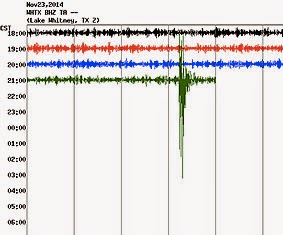
A seismograph recorded the 3.3-magnitude
quake that shook the Dallas-Fort Worth
Metroplex on Nov. 22--.Credit:
University of Texas Institute of Geophysics
Those who live in states other than California often spout the refrain, “Yeah, but at least we don’t have earthquakes!” Residents of Irving, Texas, won’t be able to use that phrase anymore since at least five quakes, which might have been caused by fracking, hit the area in less than a week.

The first, and so far the biggest, was a 3.3 magnitude temblor last Saturday. There was a 2.5 on Sunday, followed by a 2.2 and a 2.3 on Monday and a 2.7 on Tuesday.

Fracking, or hydraulic fracturing, is a drilling technique wherein fluid, often toxic, is injected into wells to facilitate the removal of oil and gas. The epicenter of Saturday’s quake was very close to a fracking wastewater disposal well.

“We are guinea pigs in the middle of this fracking experiment. Texas homes are built to withstand wind, not earthquakes,” Sharon Wilson, an organizer for the advocacy group Earthworks, told Reuters. “Who will pay for the damage to private property?”

At this point, the increase in the number of earthquakes has become so obvious that the Texas Oil & Gas Association agrees that some research into the nexus of fracking and quakes is called for. “The oil and natural gas industry agrees that recent seismic activity warrants robust investigation to determine the precise location, impact and cause or causes of seismic events,” Todd Staples, the association’s president, said in a statement.

Earlier this year, the U.S. Geological Survey (USGS) connected a 5.7-magnitude quake in Oklahoma to that state’s robust fracking industry. “The observation that a human-induced earthquake can trigger a cascade of earthquakes, including a larger one, has important implications for reducing the seismic risk from wastewater injection,” USGS seismologist and coauthor of the study Elizabeth Cochran said at the time.

Residents of Denton, Texas, 35 miles from Irving, voted earlier this month to ban fracking within the city limits because of concerns about earthquakes, according to Common Dreams. However, industry groups sued to stop the ban and a state official said she won’t enforce it. So much for small government solutions.

To Learn More:

Saturday, November 8, 2014

11/08/2014 -- 3 months of Amazing Volcanic Activity show "Global Surge" and World Wide Unrest

dutchsinse | Nov 8, 2014


The world wide unrest description is not an exaggeration. As the 'professionals' made the "Global Surge" of activity a main topic of discussion at the recent geophysics conference held in the Pacific Northwest United States (Oct 2014).

Read more about the "Global Surge" of activity discussed by professionals here:

http://dutchsinse.com/10222014-global...

Thursday, October 16, 2014

Study finds fracking triggered 400 earthquakes in Ohio

AFP Photo / Mladen Antonov
RT | Oct 15, 2014 |

A new study on the practice of hydraulic fracturing has found a direct connection to some 400 micro-earthquakes in an Ohio town. This is the second report on the Utica Shale this year. The town is one of very few where the quakes took place on a fault.

The new study, published Tuesday in the journal Seismological Research Letters, focuses on the eastern town of Canton, Harrison County, and three particular wells. It has found that the three wells operated in September-October 2013 in the Utica Shale caused 10 quakes of magnitude 1.7-2.2, among others.
But the case of Harrison County is one of a very few where, according to seismologist and lead author Paul Friberg, the quakes happened on a fault line.

Other locations where this happened included the United Kingdom, British Columbia in Canada and Poland Township, Ohio, according to LiveScience.

An earlier March study led to scientists with Ohio’s Department of Natural Resources to shut down seven other wells in the Poland Township after fracking there led to two small quakes.

The current spate of Harrison County quakes struck less than 1.4km (1 mile) below ground, with tremors starting to be felt 26 hours after fracking started on September 29, 2013. This was followed by a total of 190 earthquakes in the 39 hours just two days later. When the pressure stopped, so did the quakes, according to the study.


Ohio Department of Natural Resources spokeswoman Bethany McCorkle told the AP that over the past year new seismic monitoring equipment has been installed in eastern Ohio in order to monitor for stronger quakes.

There is also an opinion that some underground dangers cannot be spotted until hydraulic fracturing is carried out there. In this sense, the findings can be used to prevent further, worse quakes.

It has been known for a while that hydraulic fracturing – which implies pumping huge quantities of water, chemicals and sand into rock to shatter it and extract oil and gas – leads to earthquakes. But it was previously thought that the effect is negligible. Now a growing body of evidence seems to suggest otherwise.

Rowena Lohman, an assistant professor of geophysics at Cornell University, who was not involved in the study, told AP that the oil and gas community have “known for a really long time, going back to the '70s, that when you do any subsurface manipulation you cause small earthquakes,” but also that “the big question is: are we doing something now that increases the probability that it will induce larger quakes?”

It was found in another, unrelated study that just four wastewater wells in Oklahoma – where water is stored after fracking completes – are to blame for a massive number of earthquakes this year all taking place within a 30km radius.


As with Ohio, incidences of earthquakes increasing as a result of fracking have been witnessed largely in Oklahoma. Similar problems are affecting Colorado, where a well was shut down after a small earthquake caused by an injection well in Weld County.

Idaho and Texas are among other states which have directly suffered from the practice.

In July this year, the USGS also released a report that predicted the number of states with earthquakes to double over the next 50 years. This prediction concerns events that actually cause damage.

Wednesday, October 15, 2014

North California must brace for major earthquake in near future - US Geological Survey

San Francisco.(Reuters / Robert Galbraith)
RT | Oct 14, 2014

Four segments of the San Andreas fault system in Northern California are due for an earthquake of magnitude 6.8 or greater, including a section that runs near infrastructure crucial to water supply in much of the state, according to a geological study.

The Green Valley fault northeast of San Francisco between the cities of Napa and Fairfield is poised for a magnitude-7.1 earthquake or stronger, said researchers from the US Geological Survey and San Francisco State University responsible for the report.

The fault is located near dams and aqueducts that supply water from the Sacramento and San Joaquin rivers to the San Francisco Bay area, Southern California, and the farm-heavy Central Valley. The Green Valley fault’s last quake happened “sometime in the 1600s,” AP reported.

The northern Calaveras and Hayward faults in the eastern San Francisco Bay area, as well as the Rodgers Creek fault to the north, are the other segments with enough built-up tension for a magnitude-6.8 or higher quake, the researchers found.

The study, published Monday in the Bulletin of the Seismological Society of America, shows that California "needs to consider more seriously" the major earthquake risks in the region, James Lienkaemper, a US Geological Survey geologist and lead author of the study, told AP.

A passerby stops to take a picture of the
earthquake-damaged Vintner's Collective building
on August 26, 2014 in Napa, California.
(Justin Sullivan / Getty Images / AFP)
The four segments at risk are part of the San Andreas fault system, the point at which the western half of the state is moving northwest away from the rest of the United States land mass at a rate of about 2 inches per year.

In 2006, a study of the San Andreas system found that it was past due for a major earthquake, one at least magnitude 7.0, especially in the southern section of its reach. The southern region of the fault has not seen a massive quake for around 300 years, the study concluded.

"The information available suggests that the fault is ready for the next big earthquake but exactly when the triggering will happen and when the earthquake will occur we cannot tell [...] It could be tomorrow or it could be 10 years or more from now," said author Yuri Fialko, of the Institute of Geophysics and Planetary Physics of the Scripps Institution of Oceanography at the University of California San Diego.

Damage to a downtown building is seen after
an earthquake in Napa, California
August 24, 2014. (Reuters / Stephen Lam)
Researchers for the report released Monday gathered data in part from regular readings of fault lines taken by geologists and San Francisco State University students beginning in 1979.

These surveys measure fault creep, or movements over time that relieve strain on faults. If there is no fault creep, this indicates that a fault is locked and strain builds until an earthquake releases it. About two-thirds of the 1,250-mile San Andreas fault system shows fault creep, the study found.

In late August, a magnitude-6.0 earthquake hit the region, in the Napa Valley. Around 100 people were injured, mostly from stumbling on broken glass and other debris after the temblor hit before dawn on Aug. 24. At the time of the quake, officials speculated that costs from the damage would reach more than $1 billion.

The quake was the region’s largest in 25 years. On Oct. 17, 1989, the magnitude-6.9 Loma Prieta quake struck the San Francisco-Oakland area, killing more than 60 people, most from a freeway collapse.

Tuesday, September 16, 2014

Southwest's Earthquake Spike Linked to Injection Wells

A drilling rig used for fracking.
Live Science | Sep 15, 2014 | Becky Osken


A dramatic increase in earthquakes in a small region of New Mexico and Colorado was triggered by the underground disposal of wastewater, according to a new study from the U.S. Geological Survey (USGS).

There was a 40-fold increase in earthquakes in the area since 2001, compared to over the last three decades, the researchers found. The series of quakes includes Colorado's largest shaker since 1967 — the magnitude-5.3 earthquake that struck Trinidad, Colorado, on Aug. 22, 2011 — which cracked walls and toppled chimneys.

"It's been a pretty remarkable increase in earthquakes," said lead study author Justin Rubinstein, a USGS geophysicist in Menlo Park, California. [The 10 Biggest Earthquakes in History]

Just a handful of high-volume injection wells are responsible for the earthquakes in the region, known as the Raton Basin, according to the study published today (Sept. 15) in the Bulletin of the Seismological Society of America. There is no evidence linking the earthquakes to hydraulic fracturing, Rubinstein said. "I'm not aware of any fracking that's occurring in the area," he told Live Science.

The research adds to growing scientific evidence that high-volume wastewater injection wells cause earthquakes in certain settings. Oklahoma was outpacing California in earthquakes earlier this year — a spike that several previous studies attributed to injection wells. But most of the 680,000 disposal wells in the United States aren't rattling their neighbors.

Many scientists and regulators think monitoring injection wells with seismometers could help quell the strongest shaking, by turning down the volume before big quakes strike. States such as Oklahoma are considering rules to lower pumping volumes when earthquakes start up near wells.

Rubenstein said the injection rates for Raton Basin wells were higher than those at Colorado's Rocky Mountain Arsenal, where geologists first proved in 1967 that pumping fluids underground could trigger earthquakes. One Raton Basin well was forcing more than 480,000 barrels of water (about 57.2 million liters) into the ground per day.

The Raton Basin is a series of contorted rock and coal layers in the Rocky Mountain foothills. Energy companies drilling for methane in the region will sometimes hydraulically fracture, or frack, the rock to help gas and water flow more easily toward wells. Mostly, operators simply pump water out of the coal to force natural gas toward the surface.

The excess groundwater is then pushed back underground via deep disposal wells. The amount of water injected into the basin tripled between 1999 and 2004, according to the Environmental Protection Agency.

As was documented in Oklahoma, earthquake rates in New Mexico and Colorado got a boost when oil and gas companies turned up the tap on their injection wells. The frequency of earthquakes increased shortly after a jump in the number of barrels per day.

The first earthquake swarm hit near Trinidad, Colorado, from August to September 2001. The remote region was rattled by 11 magnitude-3 earthquakes and two magnitude-4 earthquakes in a month. The researchers pinned the blame on a single high-volume injection well.

Another seismic spike started 10 years later, between August and September 2011. The swarm culminated in the region's largest earthquake in decades, the magnitude-5.3 Trinidad earthquake. Two adjacent injection wells were blamed for this quake cluster, according to the study.

Small earthquakes continued to strike the region occasionally after each quake cluster died down. Since 2001, there have been 16 earthquakes larger than magnitude-3.8 in the Raton Basin, compared to only one in the previous 30 years, the researchers said. All of these quakes occurred within 3.1 miles (5 kilometers) of wastewater injection wells.

"The earthquakes are centered right on these injection wells," Rubinstein said.

Email Becky Oskin or follow her @beckyoskin. Follow us @livescience, Facebook & Google+. Original article on Live Science.

Sunday, September 7, 2014

Health Impacts of “Smart Meters”. Florida Media Ignores Dangers of Exposure to Non-ionizing Microwave Radiation

Smart Metering
© unknown
Global Research | Sep 6, 2014 | James F. Tracy

In a recent editorial, “Smart-meter Phobia Sad, But Don’t Cut Power,” the Palm Beach Post hyped safety claims of Florida Power and Light / Next Era Energy accompanying the utility’s statewide “smart meter” deployment while condemning the roughly 6,000 Florida households that have declined such technology.

The Post often weighs in on regional and state affairs with a discriminating editorial voice. In this instance, however, the paper’s editorial staff has chosen to ignore hard scientific data that clearly lay out the health-related dangers of exposure to the non-ionizing microwave radiation emitted by smart meters and similar wireless technologies.

Indeed, the Post’s editorial reads almost as if it was authored by FPL’s own public relations department, for it is replete with most every poorly-conceived and quasi-scientific claim the utility transmits to its broad customer base.

According to the editorial, the fears of “smart meter” technology are rooted in a small segment of the public too easily influenced by internet fear-mongering that has characterized the debate over childhood vaccination and global warming. “One of the latest internet-fueled fears,” the editors argue, “is of utility company ‘smart meters.’ Using a battery, a modem and seconds-long pulses of UHF (ultra-high frequency radio waves) these meters transmit customers’ energy-use data for billing accuracy and service reliability … But some people fear them.”

The health-related concerns over the electrical meters are in fact well-founded, yet one must look beyond their given utility’s promotional paraphernalia to assess safety claims—something that journalists are supposed to do. This author has repeatedly communicated with Florida Power and Light regarding the safety of such devices (e.g. here, here, and here) and assiduously researched the topic (here, here, here, here, and here). In 2013 Project Censored, an organization comprised of knowledgeable scholars and journalists, recognized his research in this regard.

Most recently, the writer communicated with and interviewed FPL spokespersons, presenting them with the 2012 Bioinitiative Report—a comprehensive set of 1,800 new scientific studies documenting in no uncertain terms the dangers of non-ionizing radiation to human health—the type of radiation emitted by “smart meters” and like technology. “Cell phone users, parents-to-be, young children and pregnant women are at particular risk,” the Bioinitiative Working Group observes.

After forwarding the Bioinitiative Report to FPL representatives the author had established a rapport with, they refused to respond and severed further communication.

Ironically, both Florida Power and Light and the Palm Beach Post refuse to concede hard scientific findings demonstrated in the immense body of scientific research dating to the 1960s while claiming to occupy the scientific high ground. They can’t have it both ways, and by failing to even consider such data the Post in particular has chosen a poorly-informed and thus journalistically irresponsible stance.

Most disturbingly, there is little difference between FPL’s public relations pronouncements and the Post’s. Each entity reasons that because most of the utility’s “approximately 4.6 million customers have adopted the new technology without a second thought,” the technology is inherently safe.

In fact, FPL deployed such microwave technology on Florida homes and businesses without allowing its customers a second thought, apart from a postcard suggesting that the meter swap was basically a fait accompli.

Moreover, the Florida Public Utility Commission that quickly approved the “smart meter” deployment was misled by FPL which, in its zeal to roll out its smart grid and collect federal subsidies supporting the operation, consciously omitted the abundance of published scientific investigations and failed to conduct adequate human health impact studies before implementation. Instead, it relied on health impact guidelines that are close to 20 years old and overseen by an agency that has absolutely no mandate to oversee such concerns—the Federal Communications Commission.

The Post concludes that before FPL cuts off the power to what it mockingly deems “refuseniks” and “octagenarians,” who remain understandably wary of such technological ultimatums and refuse to pay FPL’s monthly “opt out” fees, it should consider the public relations consequences of such heavy-handedness. “Some people’s minds won’t be changed, no matter what the evidence.”

Indeed, given its journalistic role and duty to conscientiously inform public opinion, the Palm Beach Post should likewise consider much more than the “evidence” it has been spoon-fed by power industry spinmeisters.

Tuesday, July 15, 2014

Seven Earthquakes Hit Oklahoma in 14 Hours, Raising Fracking Concerns

Source: USGS and Oklahoma
Geological Survey, May 2, 2014
Common Dreams | Jul 14, 2014 | Deirdre Fulton

Studies have linked wastewater injection to increasing seismic activity 

Seven small earthquakes shook Oklahoma within 14 hours this weekend, lending further credence to the claim that fracking increases seismic hazards.

This weekend's quakes registered between 2.6 and 4.3 on the Richter scale. Last month, Oklahoma passed California as the state with the most earthquakes, and scientists believe the increase is man-made.

In a joint statement earlier this year, the US Geological Survey and the Oklahoma Geological survey noted that the changes in earthquake rates "do not seem to be due to typical, random fluctuations in natural seismicity rates."

The statement continued: "The analysis suggests that a likely contributing factor to the increase in earthquakes is triggering by wastewater injected into deep geologic formations. This phenomenon is known as injection-induced seismicity, which has been documented for nearly half a century, with new cases identified recently in Arkansas, Ohio, Texas and Colorado."

So the earthquakes are linked not to the oil- or gas-extraction process, but to wastewater disposal, in which large amounts of water are injected underground where they can lubricate fault lines for 20 miles.

According to a study published this month in the journal Science, that injection process sends "a wave of water pressure coursing through the subsurface. The pressure can reduce forces acting to keep faults locked and trigger earthquakes."

While the link is not definitive, the U.S. Geological Survey has begun researching and mapping man-made earthquakes.

"It's pretty clear high-volume pumping is having an impact on the natural system," said study co-author Geoff Abers, a Cornell University geophysicist. "Modern waste disposal wells can trigger earthquakes."

At a town meeting in Edmond, Oklahoma at the end of June, some citizens called for a moratorium on injection wells.

But state officials said a moratorium would make it more difficult to study the quakes, according to reporting in the Oklahoman. State Geological Survey seismologist Austin Holland told the crowd that stopping the use of injection wells "would not be recommended from a scientific standpoint because that would rob researchers of valuation data that could help them figure out how to prevent earthquakes."

“You want to study us like animals,” one man said in response. “Do you want a 7.0 (earthquake) that leveled Haiti to occur in the middle of Edmond?”

Saturday, July 5, 2014

Just 4 fracking wastewater sites cause 20 percent of all central US earthquakes – study

New Dominion disposal well in Oklahoma
(Photo: New Dominion)
RT | Jul 4, 2014

Just four wastewater wells in Oklahoma – where energy companies dump water after completing the hydraulic fracturing process – have caused scores of earthquakes this year, some 30 km from the site, according to a new study by top US universities.

The report, published in Science magazine, focused on the Midwestern state, which has produced 45 percent of the country’s magnitude 3 or bigger seismic shocks in the past five years – with the numbers rising rapidly to match the intensification of fracking activities in the area.

While hydraulic fracturing, or fracking, – which involves pressuring rock formations with liquid until they crack, and then extracting the oil and gas within – poses an inherent risk of earthquakes, according to the authors, the biggest culprits were the wastewater wells, where the liquids used for fracking are pumped, once a reservoir is opened.

“The disposed fluids are capable of contributing to the seismic activity,” Katie Keranen, a geophysics professor at Cornell, and the lead author of the study, told The Oklahoman newspaper.

“These wells are capable. That doesn’t exclude anything else from contributing, but we have no reason to think these are tectonic. They don’t match tectonic activity in other areas. It does seem these are just linked to wastewater. Our research focuses on wastewater and shows it is sufficient.”

Because of a paucity of real data from the thousands of sites in Oklahoma, the team, which included a member from the US Geological Survey, used a three-dimensional model of the underground formations in the area, and then combined that with real liquid injection rates in the area.

There are more than 4,500 active disposal wells in the state, but scientists found that of those, four large wells collectively responsible for pumping 5 million barrels – the equivalent of more than 200 Olympic swimming pools – of liquid into the ground each month, exceed a threshold beyond which disproportionately large earthquakes can happen.

“These really big wells have the biggest impacts on the system,” said Geoffrey Abers, one of the authors, and a professor at Columbia University's Lamont-Doherty Earth Observator.

New Dominion disposal well in Oklahoma
(Photo: New Dominion)
“The earthquakes themselves seem to occur on small discrete faults. As the pressure builds up in the sedimentary formation that they are pumped into... They put that fault over the edge by jacking up the pore pressure.”

The researchers have not named the four sites, though they are located around Oklahoma City. This is particularly alarming, as the academics say that the impact of the earthquake in their model was as far as 22 miles away (the previous limit was thought to be about, and also could happen even after the disposal well was shut down.

This is a situation where the pumping starts months or a couple of years before the earthquakes are observed at all,” said Abers.

New Dominion, which operates the biggest wastewater wells in the state, has dismissed the simulation used to draw the conclusions.

"An initial review reflects it is premised on certain false assumptions," said company spokesman Jack Money. "At best these incorrect assumptions are irresponsible."

The oil and gas industry – which directly or indirectly employs 1 in 6 in the formerly lagging state – has also urged caution.

“As an industry, we’ve been saying we need more data and we need to work with regulators and others to help determine what is causing the significant increase in seismic activity,” said Chad Warmington, president of the Oklahoma Oil and Gas Association. “But to unequivocally link it to wastewater injections, I think there still needs to be more research.”

Between 1967 and 2000, there was an average of 21 earthquakes of a magnitude greater than 3.0 – considered strong enough to be noticed - in Oklahoma. Last year there were over a hundred, and this year there have been more than 200.

State industry regulator, the Oklahoma Corporation Commission, said it would not comment on the findings until it had a chance to examine them carefully.

Saturday, April 12, 2014

Ohio investigation connects earthquakes to fracking

AFP Photo/Don Emmert
RT | Apr 12, 2014 |

Ohio geologists have linked minor earthquakes in a rock formation underneath the Appalachians to hydraulic fracturing, a first in the state. The finding has caused the state to offer new permit rules for some areas targeted for oil and gas development.

The state investigated five small quakes that occurred last month near Youngstown, finding the hydraulic fracturing, or fracking, process of injecting water and sand into the Utica Shale put pressure on a small fault line, State Oil & Gas Chief Rick Simmers said. He added that the link was “probable,” according to AP.
Simmers said this was the first time tremors in this part of the Appalachian region have been directly associated with fracking. Though he said some quakes in the area had been linked to deep-injection wells that are used to dispose of the massive amount of toxic wastewater the fracking process demands.

To unleash natural gas deep underground, fracking requires large volumes of water, sand, and chemicals to be pumped underground. This process has been linked to groundwater contamination, seismic activity, and other health concerns for humans and the local environment.

Ohio said the company responsible for setting off the tremors – which were not easily noticed by area residents – seems to have followed state rules for fracking.

The Appalachian region – with its gas-rich Marcellus Shale, which sits above the Utica Shale – has been a particular hotbed for fracking activity. Energy companies have drilled thousands of “unconventional gas wells in recent years,” according to AP.

In response to the quake findings, Ohio issued new permits for drilling sites within three miles “of a known fault or seismic activity of 2.0 magnitude or higher.” These sites will be required to have high-tech seismic-monitoring equipment. Regulators will have direct access to any results from the instruments, Simmers said.

If a quake of 1.0 magnitude or higher is detected, drilling at the site will be suspended until further evaluation. If a link between the fracking activity and the tremors is found, the drilling will be put on hold.

Ohio has instituted an indefinite drilling moratorium at the site of the March tremors, while oil and gas extraction has been allowed to continue at five existing wells at the site.
 
"While we can never be 100 percent sure that drilling activities are connected to a seismic event, caution dictates that we take these new steps to protect human health, safety and the environment," said James Zehringer, director of Ohio's natural resources department.

State regulators all over the US will likely study Ohio’s actions for implications to the industry in general, said Gerry Baker, associate executive director of the Interstate Oil and Gas Commission. Oil and gas drilling has boomed across the US in places with varying rock formations. Thus, Ohio’s findings may not easily translate to other areas where fracking is prevalent.

Meanwhile, geologists have linked an unprecedented spate of seismic activity in Oklahoma to fracking in the state.

In March, it was reported that regulators in Oklahoma, Ohio, Kansas, and Texas discussed how to mutually strengthen fracking standards. According to Bloomberg News, they are also working on establishing similar monitoring procedures across the states that would prevent earthquakes from occurring in the future.

Monday, March 31, 2014

12 Signs that something big is happening to the Earth's crust under North and South America

© The Economic Collapse Blog
Sott.net | Mar 30, 2014 | Michael Snyder \ ECB

Why are fault lines and volcanoes all over North and South America suddenly waking up? Are we moving into a time when major earthquakes and volcanic eruptions will become much more common?

For the past several decades, we have been extremely fortunate to have experienced a period of extremely low seismic activity along the west coast of the United States. You see, the west coast lies right along the infamous Ring of Fire.

Approximately 75 percent of all the volcanoes in the world are on the Ring of Fire, and approximately 90 percent of all global earthquakes occur along the Ring of Fire.

Scientists tell us that it is inevitable that "the Big One" will hit California someday, but people have gotten very apathetic about this because things have been so quiet out there for so many years.

Well, now it appears that things are changing in a big way - and not just along the California coast. The following are 12 signs that something big is happening to the earth's crust under North and South America...

#1 The 5.1 earthquake that shook Los Angeles on Friday was the worst earthquake that the city had seen in many years.

#2 Following that earthquake, there were more than 100 aftershocks.

#3 A 4.1 earthquake shook Los Angeles on Saturday. Scientists are hoping that this earthquake swarm in southern California will end soon.

#4 Earlier this month, a 4.4 earthquake rattled Los Angeles so badly that it caused news anchors to dive under their desks.

#5 A 6.9 earthquake just off the coast of northern California in early March was the largest earthquake to hit the west coast of the United States since 2010.

#6 Up in Oregon, Mt. Hood recently experienced more than 100 earthquakes over the course of just a few days.

#7 During the past month, there have also been some other very unusual geologic events that have been happening up in Oregon...
  • Two large landslides - one in the Columbia River Gorge dumped about 2,000 cubic yards of rock and debris on highway I84 just 3 miles west of the Hood River, and another blocked US30 near Portland.
  • Loud booms and ground shaking reported by people from Lincoln to Tillamook Counties; some reported hearing a rumble, as well (No earthquakes recorded by the USGS in the area at the time.)
  • A 20 ft. deep sinkhole swallowed a woman and her dog in her Portland backyard.
#8 A 4.8 earthquake rattled Yellowstone National Park on Sunday, and there have been at least 25 earthquakes at Yellowstone since Thursday.

#9 Scientists recently discovered that the Yellowstone supervolcano is now releasing far more helium gas than they had anticipated.

#10 Over the past month, there have been more than 130 earthquakes in the state of Oklahoma. This is highly unusual.

#11 There have been several dozen earthquakes in Peru over the past month, including a 6.3 earthquake that made headlines all over the globe.

#12 Earlier this month, the northern coast of Chile was hit by more than 300 earthquakes in a seven day stretch. 41 of those earthquakes were stronger than magnitude 4.5.

Fortunately, the quake that hit Los Angeles on Friday did not cause too much lasting injury. But it sure did shake people up. The following is how the Los Angeles Times described the damage...
The quake, centered near La Habra, caused furniture to tumble, pictures to fall off walls and glass to break. Merchandise fell off store shelves, and there were reports of plate glass windows shattered.

In Brea, several people suffered minor injuries during a rock slide that overturned their car. Fullerton reported seven water main breaks. Carbon Canyon Road was closed.

Residents across Orange and Los Angeles counties and the Inland Empire reported swinging chandeliers, fireplaces dislodging from walls and lots of rattled nerves. The shake caused a rock slide in Carbon Canyon, causing a car to overturn, according to the Brea Police Department.
Why this particular earthquake is of such concern is because it occurred along the Puente Hills fault line. According to one seismologist, this is the fault line that would be most likely to "eat L.A."...
Experts said that the earthquakes occurred on the Puente Hills thrust fault, which stretches from the San Gabriel Valley to downtown Los Angeles.

Last night's quake was shallow, which 'means the shaking is very concentrated in a small area,' said Caltech seismologist Egill Hauksson.

Hauksson revealed that the earthquake was unusual because the 5.1 quake was preceded by the weaker foreshock.

Scientists such as Hauksson are very concerned about the Puente Hills fault because it runs directly under downtown Los Angeles.

'This is the fault that could eat L.A.,' seismologist Sue Hough told The LA Times in 2003.
The fact that this fault appears to be waking up is really bad news.

According to seismologists, a major earthquake along this fault line could cause hundreds of billions of dollars of damage...
Video simulations of a rupture on the Puente Hills fault system show how energy from a quake could erupt and be funneled toward L.A.'s densest neighborhoods, with the strongest waves rippling to the west and south across the Los Angeles Basin.

According to estimates by the USGS and Southern California Earthquake Center, a massive quake on the Puente Hills fault could kill from 3,000 to 18,000 people and cause up to $250 billion in damage. Under this worst-case scenario, people in as many as three-quarters of a million households would be left homeless.
For years, we have watched as the rest of the Ring of Fire has been absolutely ravaged by major seismic events.

We all remember the earthquakes that caused the Indonesian tsunami of 2004 and the Japanese tsunami of 2011.

And the world mourned when major earthquakes devastated New Zealand, Chile, Peru, Japan and the Philippines.

Scientists assured us that it was only a matter of time before the west coast started to become seismically active again, and now it is happening.

If you live on the west coast, I hope that you will consider these things very carefully.

Just because the earth under your feet has been relatively quiet for a very long time does not mean that it will always be that way.

Something big appears to be happening to the earth's crust, and you won't want to be in the "danger zone" when things finally break loose.

Thursday, January 30, 2014

How to Reduce Your Risk of Radiation (Updated)

How to Reduce Your Risk of Radiation (Updated)
Jan 29, 2014 | Washington's Blog

Preface: An Amazing Story From Nagasaki, Japan

As the following story shows, the right kind of food can help protect us from radiation.

In Fukushima Meltdown & Modern Radiation: Protecting Ourselves and Our Future Generations, Dr. John Apsley – a medical doctor, with degrees in nutrition and acupuncture – writes:
In August of 1945, St. Francis’s Hospital (Uragami Daiichi Hospital) in Nagasaki was located one mile from ground zero. The atomic bomb that exploded killed tens of thousands of Japanese. Many citizens died instantly, and many more passed on within days or weeks of the blast. The Director of Internal Medicine in the hospital, Dr. Tatsuichiro Akizuki, saved all staff members and most hospital patients by having them adhere to a strictly vegetarian diet of uncontaminated brown rice, fermented foods, sea algae and land vegetables. Sweets of all types were strictly forbidden, and salt sufficed as the main condiment. Another hospital exactly one mile from ground zero did not follow this dietary regimen. All other treatments remained constant. The loss of human life due to radiation poisoning suffered at this second nearby hospital approached 100%.
Dr. Hiromitsu Watanabe – from the Research Institute for Radiation Biology and Medicine at Hiroshima University – confirms:
In August 9th, 1945, the 2nd atomic bomb was dropped on Nagasaki. At the time, physician Tatuichirou Akizuki, worked with 20 employees, caring for 70 tuberculoses patients in” Uragami Daiichi Hospital” located about 1.4km away from the hypocenter. However, these people, including Dr. Akizuki, escaped from death caused by acute radiation damage. Dr. Akizuki conjectured that the reason there was no nuclear bomb disease was that these people had consumed cups of wakame miso soup (miso soup with garnish of wakame seaweed) 3) everyday. Later, his assumption was published in the English language for the information of the Western population. On April 26, 1986, after the accident at Chernobyl, Russia, many Europeans consumed miso soup to prevent radiation diseases.
You may assume that this story is apocryphal, but Dr. Watanabe  and his colleagues have conducted tests showing that miso reduces radiation damage in mice.

What Can We do to Reduce Radiation Risks? 

This essay provides an introduction to some of the main concepts on reducing the risk from radiation. It is broken into the following sections:

I.    Step 1: Reduce Exposure
II.  Certain Minerals Can Reduce Absorption of Harmful Radiation
III. Other Vitamins and Minerals Which Protect Against Radiation Damage
IV.  Antioxidants: Helpful Weapons Against Radiation Damage
V.   Other Things Which Offer Some Radiation Protection
VI.  What To Do If Exposed to Extremely High Doses of Radiation  

Read original..

Sunday, September 29, 2013

Industry Waste: ‘Zombie’ Endocrine Disruptors Dumped in Water Supply

© TruthStream Media
‘Zombie’ Endocrine Disruptors Dumped in Water Supply
Sept 27, 2013 | TruthStream Media | Aaron Dykes

Hormone-upsetting chemicals dumped into the environment are rising up to haunt Americans, spreading cancer and infertility around the world.


With the endocrine disrupting Bisphenol-A (BPA) – found ubiquitously in food can linings, plastic bottles, ATM receipts, toilet paper and hundreds of other products – already a major problem tied to infertility, breast cancer, low sperm counts, deformities in humans and sex morphology in aquatic wildlife, yet still unregulated by the FDA, other hormonal disruptors dumped into water supplies are emerging as major issues, too.

Watch the video:


Night of the Living BPA? ‘Zombie’ Hormone Disruptors Come Alive at Night


Now, environmentalists are concerned that hormones dumped into water – from sources like factory farm cattle operations – are at higher levels than previously thought, in part because they mysteriously regenerate at night, thwarting attempts to measure them based on assumptions about them breaking down in sunlight. From Nature.com:
“Hormone-disrupting chemicals may be far more prevalent in lakes and rivers than previously thought. Environmental scientists have discovered that although these compounds are often broken down by sunlight, they can regenerate at night, returning to life like zombies.

Risk assessments have been built on the basis that light exposure is enough to break down these products,” adds Laura Vandenberg, an endocrinologist at the University of Massachusetts in Amherst who was not involved in the study. “This work undermines that idea completely.” [emphasis added]
The Nature.com article focused on a study conducted by the University of Iowa on the use of the synthetic anabolic steroid trenbolone acetate, which frequently runs off into water supplies after some 20 million cattle across the United States convert it into the potent endocrine disruptor” 17α-trenbolone (its use, like BPA, is banned in the EU).

The going assumption from both industrialists and environmental regulators was that these chemicals were breaking down during the day as they were exposed to sunlight, rendering the effects on aquatic life, and human and animal use of the water, negligible.

However, scientists found that 17α-trenbolone “levels rebounded during the dark periods,” with variations in temperature and pH often accelerating that process. Since environmental monitors were primarily taking samples during the day, they were not recording data showing the “zombie” culturing of these – and potentially many other – endocrine disruptors.

Endocrine-Disrupting Herbicide Linked with Cancer & Birth Defects in 52 Million Americans’ Drinking Water


Meanwhile, more than 250 groups have banded together to demand that the EPA step up to the plate to ban atrazine, a toxic pesticide used primarily as a leading herbicide, that leaches into the environment and runs off into water supplies across the United States. It, too, has been linked with endocrine and hormonal disruption, and likely has widespread environmental effects.

Like BPA and trenbolone acetate, atrazine – sold by the biotech giant Syngenta – is already banned in European countries, but remains virtually unregulated in America.

According to EcoWatch:
“Up to 80 million pounds of it are used in the U.S. each year, contaminating ground, surface and drinking water. Atrazine, or its primary degradate, was found in approximately 75 percent of stream water and about 40 percent of all groundwater samples from agricultural areas tested in an extensive U.S. Geological Survey study.”

“In people, atrazine exposure may be linked to increased risks of thyroid cancer, reproductive harm and birth defects. For example, a recent study showed that children of mothers exposed to Atrazine had an increased risk of a birth defect called choanal atresia, a narrowing or blockage of the back of the nasal canal that can be life-threatening in newborn infants.”
The hormone disrupting pesticide has been found in the drinking water of at least 52 million Americans. I previously reported on a little-noticed item in the Wall Street Journal in 2012, quietly announcing that the biotech firm Syngenta had settled a class action lawsuit with more than 2,000 water districts in the American Midwest over the contamination of its drinking water supplies.

The terms of the settlement were not fully disclosed, and Syngenta admitted no liability, maintaining that atrazine is “safe,” and stating that, “No one ever has or ever could be exposed to enough atrazine in water to affect their health.”

Wednesday, August 7, 2013

Homeowner files class action lawsuit to stop smart meters

© Natural News
Homeowner files class action lawsuit to stop smart meters
Aug 7, 2013 | Natural News | Lloyd Burrell

Smart meters, aka wireless utility meters, even though never tested for their effect on human beings, are now being rolled out on a massive scale to measure a household's electrical, gas, and water usage all across the country and around the globe.

Nomi Davis says 'enough'. Enough of being coerced and intimidated by a company that has no regard for freedom of choice or living a life without fear and risk of possible dire health consequences. Davis, a fed-up homeowner who resides in Salt Spring Island, Vancouver has taken action against the British Columbia Hydro and Power Authority to demand freedom of choice for all of BC Hydro's customers. Davis's class action lawsuit, filed July 25th of this year, addresses BC Hydro's attempt to remove their customers' basic civil rights by using coercive tactics in order to implement their rigid smart meter installation program; a program that is intrusive and possibly life threatening.

Public fears well founded 

Public fears about smart meter installations are well founded. They are backed by a growing number of medical authorities, such as those of the Santa Cruz County (California) Public Health Department, who are voicing concerns. These authorities are worried about the growing number of people who say they have developed electrical sensitivity (ES) and other health complaints. In many cases, their symptoms developed after the installation of wireless smart meters.

Smart meters emit a type of electromagnetic field called radio-frequency (RF) radiation. The International Agency for Research on Cancer (IARC), has clearly singled out RF radiation, as emitted by smart meters and similar wireless devices, as a possible Class 2B carcinogen. These type of radiation exposures have been found to contribute to DNA damage (an indirect link to cancer), and the creation of free radicals; molecules which damage cells and are associated with cancer.

Dr. Vini G. Khurana, neurosurgeon and Associate Professor at the Australian National University Medical School shares his concerns. "Adverse neurological effects have been reported in people who sustain close proximity to wireless meters, especially under 10 feet. If a smart meter is located on a common wall with a bedroom or kitchen, the RF exposure can be the same as being within 200 to 600 feet distance of a cell tower with multiple carriers." Smart meter radiation exposure is particularly dangerous due to the prolonged, 24/7, nature of the exposure.

Legal action is the only solution for some 

The single best approach to avoid the installation of a smart meter is to choose the opt-out option. This may or may not be an easily accessible avenue to take depending upon the policy of the company installing the smart meters. Some investigatory action will determine whether or not a particular company provides a way out or if company policy dictates mandatory installation. If mandatory, there is no opting out without pursuing legal action.

There are a number of lawsuits currently in motion against smart meter installations. Court cases have already been won in Portland, Maine and Hawaii. In a recent lawsuit brought against Southern California Edison, the judge ordered the utilities company to pay for health damages or remove the meter.

Citizen rights 

It is within a citizen's right and ultimately their power to choose a wired meter over a wireless smart meter. The right decision means a decrease in the exposure to dangerous RF radiation and the risks that come with that exposure.

Sources for this article include:

http://citizensforsafetechnology.org

http://www.globalresearch.ca

http://smartmeterlawsuits.blogspot.fr

http://maisonsaine.ca

http://science.naturalnews.com

About the author:

Lloyd Burrell is the author of a new ebook entitled "How To Beat Electrical Sensitivity" which offers a solution to the growing number of people whose health is being compromised by exposure to wireless and similar technologies, see www.electricsense.com/3-free-chapters.html

Since falling prey to a violent reaction to his cell phone in 2002 he has spent the last 10 years researching the effects of electromagnetic fields (EMFs) on health. He now offers a complete solution on how to live a healthy life in our increasingly electromagnetic world.

You can download his free EMF Health Report and subscribe to his newsletter by visiting his website http://www.electricsense.com/. You can also follow him on Facebook , Twitter and Youtube.