Friday, April 25, 2014

The Electric Comet Hale-Bopp | Space News

ThunderboltsProject | Apr 25, 2014 | Subscribe

A team of scientists analyzing the coma and tail of Comet Hale- Bopp have published their observations in a landmark paper. What they discovered cannot be explained by the standard model of comets. The scientists analyzed the comet's surprising coma and tail at distances up to 27 times the average distance between the Earth and Sun. The structure of the comet's tail and its relative brightness at such a large heliocentric distance remains a mystery for comet scientists.

Excess Antarctic Sea Ice Area Approaching The Highest On Record

Real Science | Apr 24, 2014 


Thursday, April 24, 2014

60% Of China's Water "Too Polluted To Drink"

Zero Hedge | Apr 23, 2014 | Tyler Durden

Forget bank-runs, the water run has begun in China. Residents of the western city of Lanzhou rushed to buy mineral water earlier this month after local tap water was found to contain excessive levels of the toxic chemical benzene. But that is the tip of what is a massive problem facing the Chinese people. Not only do they suffer choking smog day after day, but, as The Business Times reports, sixty per cent of underground water in China which is officially monitored is too polluted to drink directly, state media have reported, underlining the country's grave environmental problems.


As The Business Times reports,
Sixty per cent of underground water in China which is officially monitored is too polluted to drink directly, state media have reported, underlining the country's grave environmental problems.

Water quality measured in 203 cities across the country last year rated "very poor" or "relatively poor" in an annual survey released by the Ministry of Land and Resources, the official Xinhua news agency said late Tuesday.

Water rated "relatively" poor quality cannot be used for drinking without prior treatment, while water of "very" poor quality cannot be used as a source of drinking water, the report said.

The proportion of water not suitable for direct drinking rose from 57.4 per cent from 2012, it said.
As we noted previously, The World Bank's Ismail Serageldin puts it succinctly: "The wars of the 21st century will be fought over water."

That old axiom that the earth is 75% water... not quite. In reality, water constitutes only 0.07% of the earth by mass, or 0.4% by volume.

This is how much we have, depicted graphically:
That old axiom that the earth is 75% water... not quite. In reality, water constitutes only 0.07% of the earth by mass, or 0.4% by volume.

This is how much we have, depicted graphically:


What this shows is the relative size of our water supply if it were all gathered together into a ball and superimposed on the globe.

The large blob, centered over the western US, is all water (oceans, icecaps, glaciers, lakes, rivers, groundwater, and water in the atmosphere). It's a sphere about 860 miles in diameter, or roughly the distance from Salt Lake City to Topeka. The smaller sphere, over Kentucky, is the fresh water in the ground and in lakes, rivers, and swamps.

Now examine the image closely. See that last, tiny dot over Georgia? It's the fresh water in lakes and rivers.
There's no doubt that this is a looming crisis we cannot avoid. Everyone has an interest in water. How quickly we respond to the challenges ahead is going to be a matter, literally, of life and death. Where we have choices at all, we had better make some good ones.

'Straight from the Horse's Mouth': Former Oil Exec Says Fracking Not Safe

Groups in New York are pushing Governor
Andrew Cuomo to ban fracking in the state.
(Photo: Credo.fracking/ Creative Commons)
Common Dreams | Apr 23, 2014 | Lauren McCauley

Retired Mobil VP confirms technology is dangerous and untested 

In a message "straight from the horse's mouth," a former oil executive on Tuesday urged New York state to pass a ban on the controversial practice of hydraulic fracturing, or fracking, saying, 'it is not safe.'

"Making fracking safe is simply not possible, not with the current technology, or with the inadequate regulations being proposed," Louis Allstadt, former executive vice president of Mobil Oil, said during a news conference in Albany called by the anti-fracking group Elected Officials to Protect New York.

Up until his retirement in 2000, Allstadt spent 31 years at Mobil, running its marketing and refining division in Japan and managing Mobil's worldwide supply, trading and transportation operations. After retiring to Cooperstown, NY, Allstadt said he began studying fracking after friends asked him if he thought it would be safe to have gas wells drilled by nearby Lake Otsego, where Allstadt has a home. Since that time, he's become a vocal opponent of the shale oil and gas drilling technique.

"Now the industry will tell you that fracking has been around a long time. While that is true, the magnitude of the modern technique is very new," Allstadt said, adding that a fracked well can require 50 to 100 times the water and chemicals compared to non-fracked wells.

Read more..

Agenda 21: Food Is The New Gold. Land Is The New Oil.


Underground Medic | Apr 21, 2014 | Liz Bennett

Over the last decade world grain reserves have fallen by at least a third and that decline looks set to continue. For the last half of the 20th century overproduction was the order of the day. Huge grain surpluses, butter mountains and milk lakes dominated the news.

During this period the United States had a farm programme where land lay idle to prevent even more surpluses, this provided a cushion against shortages, the land could be planted up if the surpluses fell to levels considered to be too low. In the UK land was left fallow and green manured to enrich it for the following season. The crops were rotated and the harvests were generally very good. In addition there was the carryover: The amount of grain left in the massive storage silos at the time the next crop is harvested. Other western nations had similar systems.

1965 is a good year to show how the system cushioned against disaster. In 1965 the Monsoon in India failed. The United states shipped a full fifth of its grain harvest to India which averted a potential famine. due to the amount of surplus in store the incident had a minimal effect on grain prices on the world markets.

There were occasional spikes during the period of 1950-2000, but the effects on world prices were a short lived thing. The weather was usually to blame and after a bit of a ‘blip’ everything settled down when the amount of idled land and the amount of food commodities in store were announced.

In 1950 the world had a population of 2.5 billion souls. By 1986 world demand for grain was rising rapidly due to an ever increasing population and the prices were starting to rise. In an effort to keep a surplus and to reduce or at least to stabilise the prices, the land idling programmes were reduced in both the United States and the UK, with other countries following suit until by 1990 most agricultural land that could be farmed was farmed.

It was in the 80′s that someone, somewhere decided that biofuel was the way of the future. The global warming con artists that had infiltrated every layer of governments decided that biofuel was the answer, that clean, green fuels would stop global warming in its tracks…well, according to what they say now that wasn’t very effective, the Earth is apparently still warming. These ‘experts’ didn’t look at the global picture.

They never considered that the ever growing global population would require more and more food and that more and more arable land across the world would be given over to the growing of biofuel crops.

When realization finally dawned that food production could not keep pace something had to be done, a wide ranging plan was formulated to sell sustainability, global warming, which was now starting to be referred to as climate change, to the masses. Agenda 21 was born.

Agenda 21 basically puts the environment above the inhabitants of this planet. In order to preserve the habitat of insects and small animals nobody has ever heard of, certain regions cannot be farmed in case a moth finds itself out of a home. The scope of Agenda 21 is massive, and it affects every facet of our lives. Even those of us who refuse to comply with  the policies of the United Nations are affected by the rules and regulations of the plan.

It affects our choices on a daily basis. It affects the transport we use, the homes we live in, the kind of heating we use, the clothes we wear and the food we eat.

When Maurice Strong, then Secretary-General of the United Nations Earth summit introduced Agenda 21 20 years ago He said:
 “Current lifestyles and consumption patterns of the affluent middle class — involving high meat intake, the use of fossil fuels, electrical appliances, home and work-place air-conditioning and suburban housing — are not sustainable,”
At this point the war on carbon dioxide started. Interestingly carbon dioxide is what humans breathe out. Every breath we take in, is followed by a breath out, from birth to death respiration adds to the carbon dioxide in the atmosphere. Can we assume therefore that this is what is meant by anthropogenic global warming?
Does the man-made global warming they refer to constantly actually include breathing as a cause of pollution alongside factory output?
The United Nations, pushing its quest for a One World government fully endorse the ethos of flora and fauna over people. In fact, if they can reduce the amount of people along the way they will be exceedingly happy about it. What better way to do that than to have ‘naturally occurring famines’ that cannot be pinned on the governments of the world or on the United Nations.

Now although we are used to seeing famines in Africa I think that the trend is about to change. The peoples of Africa have a much smaller carbon footprint than we do here in The West, and for that reason a famine in the West would reduce the emissions that come from our busy, carbon-fuelled lifestyles far more readily than wiping out the entire African sub-continent.

We are also less malleable than those who have to rely on foreign aid for even their basic foodstuffs. We are more likely to cause trouble, to fight, riot and revolt if our kids are not fed. our governments know this, and in the United States they stockpile ammunition so that when the time comes they can deal with the situation.

Here in the UK there is anecdotal evidence form serving and ex-police officers,that the government does the same, but they are far less public about it. Trauma and major incident teams across the UK that used to train for multiple car pile ups and train crashes now train for civil unrest and riots as well as the more usual stuff. They practice for dirty bombs and biohazard threats, things the government says we are facing from enemies unknown.

The pieces of the puzzle are little by little falling into place. Agenda 21 is advancing rapidly.
  • We are being corralled into smaller and smaller homes that have smaller and smaller gardens.
  • Legislation and ordinances prevent many from saving God-given rainwater on their own property.
  • Ornamental flowers and lawns are to be planted instead of food we can eat in some US states.
  • Health giving raw foods are increasingly difficult to come by, especially for those in towns and cities.
  • We are discouraged from growing our own food from tried and tested heirloom seeds which are increasingly regulated.
  • Global food security is worsening with each passing year and nothing is done to address the problem.
  • Regardless of the government figures decent jobs are becoming harder to find and as a result we are rapidly moving towards the time where we will not be able to afford to feed our families.
  • Our just in time food supply chain relies on increasingly decrepit infrastructure that will fail sooner rather than later.
  • Carbon caps are seeing massive amounts of power stations closing down which even according to energy industry experts is liable to lead to blackouts.
Food really is set to become the new gold and land the new oil because without them we are done for. We have to turn back to the old ways of producing enough to look after our families. Our children need to be taught how to grow produce, how to fix things, build things and generally become more self sufficient. 

Those that do well will not be those people with fancy degrees from Ivy league universities. Those that do well will be those that can make things that are needed, those who can grow food, those turn their hand to many things. I feel confident in my view that an Honours degree in media studies is not going to be worth a damn.

Regardless of the space you have, and the conditions you have, I urge you to look into what you can grow for yourself. Think laterally, think vertically, whatever you have can be utilized in one way or another. Every single mouthful you grow you are one mouthful nearer self-sufficiency and one mouthful further away from famine...famine that is being systematically induced by the global elite and their failure to act in any way, shape or form to prevent it.

Take Care

Liz

Sources:

DEFRA
The New York Times
The Daily Telegraph
National Geographic
Project BioEnergy
Inter Press Service
The New American

Believers in global warming unchanged since 2001, 1 in 4 Americans don’t buy it at all

Watts Up With That | Apr 22, 2014 | Anthony Watts

One in Four in U.S. Are Solidly Skeptical of Global Warming

Nearly 40% are “Concerned Believers” in global warming, others are mixed
by Lydia Saad, Gallup

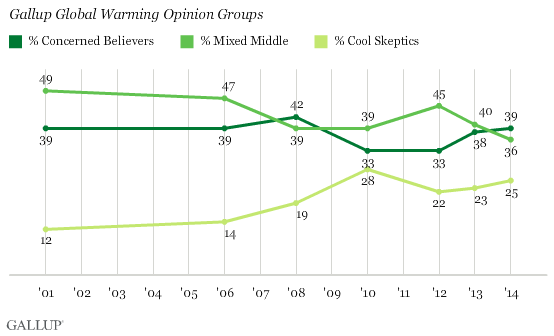
PRINCETON, NJ — Over the past decade, Americans have clustered into three broad groups on global warming. The largest, currently describing 39% of U.S. adults, are what can be termed “Concerned Believers” — those who attribute global warming to human actions and are worried about it. This is followed by the “Mixed Middle,” at 36%. And one in four Americans — the “Cool Skeptics” — are not worried about global warming much or at all.  (see graph)


The rate of Concerned Believers has varied some over the past decade and half, but is currently identical to the earliest estimate, from 2001. Over the same period of time, the ranks of Cool Skeptics have swelled, while the Mixed Middle — once the largest group — has declined modestly.

These groupings stem from a special “cluster” analysis of four questions that measure Americans’ belief and concerns about human-induced global warming, all of which have been asked together on Gallup’s annual Environment survey seven times since 2001. The latest results are from the March 6-9, 2014, Environment poll. However, the groupings derive from analysis of seven years of combined data.

Gallup has recently reported on a number of the individual trends included in the cluster analysis as part of its Climate Change series. This analysis provides a unique way of summarizing Americans’ overall stance on global warming.

Complete report here: http://www.gallup.com/poll/168620/one-four-solidly-skeptical-global-warming.aspx

Wednesday, April 23, 2014

NASA: the only thing stopping a city-destroying asteroid is blind luck


The Extinction Protocol | Apr 21, 2014

April 2014 SPACE - So you know how we all kind of thought that our odds of getting destroyed by an asteroid were remarkably low? Yeah, that was wrong. According to new research, the odds of a large-scale asteroid impact are actually three to ten times higher than we thought. And the only thing stopping total and utter destruction? Sheer, dumb luck. The unsettling revelation, which will be presented in full by three former NASA astronauts this coming Tuesday, is the result of a new visualization of data from a nuclear weapons warning network. The B612 Foundation found that 26 atomic-bomb-size explosions have happened around the world in (thankfully) remote locations since 2001. Ed Lu, the Foundation’s CEO, explains: It shows that asteroid impacts are NOT rare—but actually 3-10 times more common than we previously thought. The fact that none of these asteroid impacts shown in the video was detected in advance is proof that the only thing preventing a catastrophe from a ‘city-killer’ sized asteroid is blind luck.

We’re not totally helpless, though. Funded by the B612 Foundation and Ball Aerospace, the Sentinel Infrared Space Telescope will head into a Venus-esque orbit around the sun when it launches in 2017. From orbit, the Sentinel should have a better vantage point for spotting rogue, humanity-destroying asteroids than we’ve ever had before. We’ll get a better picture of what this all means come Tuesday, when the astronauts present their findings at the Museum of Flight in Seattle at 9pm EDT. So just to be safe, maybe hold off on rewatching Armageddon for now. – Gizmodo

Frackers Get Set to Cross the Border into Mexico


ALLGOV | Apr 22, 2014 | Noel Brinkerhoff

Mexico may become the next great fracking frontier, now that its government has opened the way for exploration into the country’s vast shale oil reserves. But U.S. drillers and hydraulic fracturing experts will have to overcome some key obstacles if they’re to profit from crossing the border.

The new opportunities have existed only since December, when Mexico’s Congress approved a landmark bill that relaxed the 75-year-old grip over oil and gas development by Pemex, the state oil monopoly. The legislation paves the way for foreign companies to cut deals with the Mexican government to develop new oil fields.

One such field is the Eagle Ford Shale Play, which straddles the Texas-Mexico border, running for hundreds of miles deep beneath the earth. On the U.S. side, companies have sunk hundreds of fracking wells into Eagle Ford, making it the second most lucrative oil field in the country.

But Mexico’s portion of Eagle Ford has barely been touched, even though it holds sizeable reserves. Between it and other shale formations, Mexico may sit atop 60 billion barrels of oil—which is more oil than the country produced through a century’s worth of conventional drilling. The country also possesses the sixth largest shale natural gas reserves in the world, according to the U.S. Energy Information Administration.

Going after the shale oil and gas could be problematic for U.S. businesses. For starters, the Eagle Ford formation rests in a part of Mexico dominated by drug smugglers, specifically the Zetas and Gulf Cartel.

 “Nabbings, extortion, murder and oil theft by the gangs have made U.S. drillers—traditionally cavalier about violence in the areas where they work—wary of venturing into the shale-rich states of Tamaulipas, Coahuila and Nuevo Leon,” Steve LeVine wrote at Quartz, a digital news outlet.

Another problem for frackers is the lack of infrastructure in this part of Mexico. Roads will need to be built and pipelines constructed to carry out oil and bring in water, of which a great deal is used in fracking operations.

It might be a while before multinational energy companies get around to exploring Northern Mexico, according toNick Miroff of  The Washington Post. They’re most interested in taking advantage of the new legislation by drilling in Gulf of Mexico oil fields in that country’s territorial waters.

To Learn More:

Fracking, Seismic Activity Grow Hand in Hand in Mexico (by Emilio Godoy, Inter Press Service)

Tuesday, April 22, 2014

NASA Expert Warns of Rogue Geoengineers and Chemtrail Consequences

TRUTHStream Media | Apr 22, 2014 | Aaron Dykes

© TRUTHStream Media
NASA Expert Clears the Air: Chemtrails are Real, Geoengineering May Be Inevitable, Mad Science in Control of Weather Could Blackmail Earth


Droughts, famine, chemtrails and the global game of risk: geoengineering is real, and inevitable part of the future, when science tries to orchestrate nature in the name of taming climate change, while experts argue over who will make the rules in the global governance of weather modification and geoengineering.

Could a rogue billionaire tinker with the delicate balance of our Earth? Might a mad scientist even “weaponize” weather control to wield power over the planet? Who calls the shots, and who watchers the modifiers?

Everything is possible, warns Riley Duren, Chief Systems Engineer at NASA’s Jet Propulsion Labs. Chemtrails and geoengineering are no longer the things of conspiratorial speculation or retro science fiction – they are the scenarios shaping the world to come as science contemplates how far is too far for man to go in the name of a global environmental crisis?

Watch the full NASA JPL presentation (Geoengineering at 32m): Geoengineering and Climate Change –February 14, 2013 at 8:54pm on NASA JPL Live (USTREAM)

NASA Admits To Chemtrails As They Propose Spraying Stratospheric Aerosols Into Earths Atmosphere

Truthstream Media – ‪Chemtrails? Watch This! Then Try to Deny It‬

Scientists: “Exclusive Club” To Assume Command Of Global Geoengineering

CIA co-sponsoring geoengineering study to look at reversing global warming options

Scientists: “Exclusive Club” To Assume Command Of Global Geoengineering

Unilateral Geoengineering Non-technical Briefing Notes for a Workshop – At the Council on Foreign Relations Washington DC, May 05, 2008

World’s biggest geoengineering experiment ‘violates’ UN rules

Government Response to the House of Commons (Science and Technology Committee 5 Report of Session 2009-10): The Regulation of Geoengineering


Strategic incentives for climate geoengineering coalitions to exclude broad participation (Ricke, Moreno-Cruz & Caldeira)

Scientists: “Exclusive Club” To Assume Command Of Global Geoengineering

Earth Is Treating Its Inhabitants To Quite A Show for Earth Day

© Prevent Disease
Prevent Disease | Apr 20, 2014

First came a Mars closeup and a Blood Moon, and now the 2014 Lyrid meteor shower. The annual fireball show is already underway, and it's expected to continue for more than a week -- with the peak arriving Earth Day, April 22.

Coronal Mass Ejections Propelling Towards Earth

A CME propelled toward Earth by an M7-class solar flare of April 18th is still en route to our planet. Forecast models predict an arrival on April 20th with a 75% chance of polar geomagnetic storms after it hits. The Solar and Heliospheric Observatory captured an image of the storm cloud billowigg away from the sun at ~1000 km/s (2.2 million mph).

NOAA forecasters expect the CME to trigger a G2-class geomagnetic storm, which is to say "moderate." High-latitude power systems may experience voltage alarms. HF radio propagation could fade at higher latitudes, and auroras have been seen as low as New York and Idaho during such storms.

What Are The Lyrids?

The Lyrid shower officially kicked off April 16 and should continue through April 25, according to NASA. Its peak typically lasts less than a day, and NASA says it will likely fall on Earth Day this year (Earth Night, actually). "This month's Lyrid meteor shower peaks on the night of April 22 and the morning of April 23," says Jane Houston Jones of NASA's Jet Propulsion Laboratory. "But you'll spot some Lyrids any night between the 16th and the 25th. The peak rate is expected to be 15 to 20 meteors per hour."

The Lyrids are named after the constellation Lyra, because that arrangement of stars -- including Vega -- marks the place in the sky where these meteors seem to originate, at least from our earthbound perspective. But Lyra is just a convenient reference point and namesake; Vega is 25 light-years away, for example, while meteors sizzle in our atmosphere only 60 miles above the surface.

The true source of the Lyrids is Comet Thatcher, a long-period comet that last visited the inner solar system in 1861. Earth passes through its orbital path every April, crashing into a cloud of comet debris left behind more than 150 years ago. As that rubble strikes Earth's upper atmosphere at 110,000 miles per hour, it vaporizes into visible streaks of light. Thatcher, meanwhile, is far away in its 415-year orbit around the sun, and won't return to our neck of the woods until 2276.

A last-quarter moon may obscure some fainter Lyrids by brightening the night sky, but it shouldn't outshine the show completely. Viewers in the Northern Hemisphere can maximize their chances of seeing a Lyrid by fleeing urban areas, avoiding artificial lights and being patient. The odds also improve as Lyra moves higher in the sky, which is why the best viewing will occur between the final hours of Earth Day and the predawn hours of April 23. Only about 10 to 20 Lyrids are expected per hour, but the shower has been known on rare occasions to produce up to 100 per hour.

The Lyrids are relatively fast-moving meteors, unlike December's Geminids, but they also tend to be bright. On top of that, about a quarter of them produce glowing trails of ionized gas known as "persistent trains," assisting skywatchers by leaving an ephemeral trace of their path to oblivion.

For more about the Lyrids, check out the infographic below (click image for larger view), which was produced by the Giant Magellan Telescope Organization to help promote the eponymous telescope it's building in Chile: