Friday, July 25, 2014

Stanford biologist warns of early stages of Earth's 6th mass extinction event

James Temple image
Activist Post | Jul 25, 2014

The planet's current biodiversity, the product of 3.5 billion years of evolutionary trial and error, is the highest in the history of life. But it may be reaching a tipping point.

In a new review of scientific literature and analysis of data published in Science, an international team of scientists cautions that the loss and decline of animals is contributing to what appears to be the early days of the planet's sixth mass biological extinction event.

Since 1500, more than 320 terrestrial vertebrates have become extinct. Populations of the remaining species show a 25 percent average decline in abundance. The situation is similarly dire for invertebrate animal life.

And while previous extinctions have been driven by natural planetary transformations or catastrophic asteroid strikes, the current die-off can be associated to human activity, a situation that the lead author Rodolfo Dirzo, a professor of biology at Stanford, designates an era of "Anthropocene defaunation."

Across vertebrates, 16 to 33 percent of all species are estimated to be globally threatened or endangered. Large animals – described as megafauna and including elephants, rhinoceroses, polar bears and countless other species worldwide – face the highest rate of decline, a trend that matches previous extinction events.

Larger animals tend to have lower population growth rates and produce fewer offspring. They need larger habitat areas to maintain viable populations. Their size and meat mass make them easier and more attractive hunting targets for humans.

Although these species represent a relatively low percentage of the animals at risk, their loss would have trickle-down effects that could shake the stability of other species and, in some cases, even human health.

For instance, previous experiments conducted in Kenya have isolated patches of land from megafauna such as zebras, giraffes and elephants, and observed how an ecosystem reacts to the removal of its largest species. Rather quickly, these areas become overwhelmed with rodents. Grass and shrubs increase and the rate of soil compaction decreases. Seeds and shelter become more easily available, and the risk of predation drops.

Consequently, the number of rodents doubles – and so does the abundance of the disease-carrying ectoparasites that they harbor.

 "Where human density is high, you get high rates of defaunation, high incidence of rodents, and thus high levels of pathogens, which increases the risks of disease transmission," said Dirzo, who is also a senior fellow at the Stanford Woods Institute for the Environment. "Who would have thought that just defaunation would have all these dramatic consequences? But it can be a vicious circle."

The scientists also detailed a troubling trend in invertebrate defaunation. Human population has doubled in the past 35 years; in the same period, the number of invertebrate animals – such as beetles, butterflies, spiders and worms – has decreased by 45 percent.

As with larger animals, the loss is driven primarily by loss of habitat and global climate disruption, and could have trickle-up effects in our everyday lives.

For instance, insects pollinate roughly 75 percent of the world's food crops, an estimated 10 percent of the economic value of the world's food supply. Insects also play a critical role in nutrient cycling and decomposing organic materials, which helps ensure ecosystem productivity. In the United States alone, the value of pest control by native predators is estimated at $4.5 billion annually.

Dirzo said that the solutions are complicated. Immediately reducing rates of habitat change and overexploitation would help, but these approaches need to be tailored to individual regions and situations. He said he hopes that raising awareness of the ongoing mass extinction – and not just of large, charismatic species – and its associated consequences will help spur change.

"We tend to think about extinction as loss of a species from the face of Earth, and that's very important, but there's a loss of critical ecosystem functioning in which animals play a central role that we need to pay attention to as well," Dirzo said. "Ironically, we have long considered that defaunation is a cryptic phenomenon, but I think we will end up with a situation that is non-cryptic because of the increasingly obvious consequences to the planet and to human wellbeing."

The coauthors on the report include Hillary S. Young, University of California, Santa Barbara; Mauro Galetti, Universidade Estadual Paulista in Brazil; Gerardo Ceballos, Universidad Nacional Autonoma de Mexico; Nick J.B. Isaac, of the Natural Environment Research Council Centre for Ecology and Hydrology in England; and Ben Collen, of University College London.

Written by Bjorn Carey. For more Stanford experts on ecology and other topics, visit Stanford Experts.

Colorado River Groundwater Disappearing at 'Shocking' Rate

A ring of light-colored rock shows how much the
water level has dropped at Nevada's Lake Mead.
Credit: U.S. Bureau of Reclamation
(CLICK FOR LARGER VIEW)
Live Science | Jul 24, 2014 | Becky Oskin

than it's being replenished, a new study finds.
As the Southwest's drought has worsened in the last decade, making surface water scarce, millions of people are drawing more heavily on underground water supplies. The water is coming out faster

Between December 2004 and November 2013, more than 75 percent of the water lost in the Colorado River Basin was from groundwater, according to the study. The region has been in a drought since 2000, according to the U.S. Drought Monitor.

The results show that groundwater is already being used to fill the gap between the demands of the region's millions of residents and farmers, and the available surface water supply, the researchers said. [Dry and Drying: See Images of Drought]

"We found a surprisingly high and long-term reliance on groundwater," study co-author Jay Famiglietti, senior water cycle scientist at NASA's Jet Propulsion Laboratory in Pasadena, California, said in a statement.

For example, the amount of land irrigated by groundwater increased since the study began in December 2004, the researchers reported July 24 in the journal Geophysical Research Letters.

The study offers a bird's-eye view of groundwater in the Colorado River Basin, one of the most heavily used and closely watched water resources in the West. More than 40 million people rely on Colorado River water in the United States alone (water is also allocated to Mexico), the U.S. Geologic Survey estimates.

"We thought the picture could be pretty bad, but this is shocking," lead study author Stephanie Castle, a water resource specialist at the University of California, Irvine, said in a statement.

The Colorado River Basin stretches across seven states: from Wyoming across Colorado, Utah, Arizona, New Mexico, Nevada and California. Its groundwater is stored in underground aquifers and is sucked from the ground by wells. If water is removed from an aquifer faster than it can be replaced, eventually the wells will go dry.

Castle and her co-authors tracked groundwater loss in the basin with NASA's twin GRACE satellites (for Gravity Recovery and Climate Experiment). The satellites circle the Earth, monitoring the slight changes in Earth's gravity from increases or decreases in water. More water means more mass, which strengthens the pull of gravity on the satellites. (The satellites also track ice — their original mission was to monitor the planet's polar ice sheets and melting glaciers.)

Since December 2004, the basin of the Colorado River lost nearly 53 million acre feet (65 cubic kilometers) of freshwater, almost double the volume of the region's largest reservoir, Nevada's Lake Mead, the researchers reported. About 75 percent of the total — about 41 million acre feet (50 cubic km) — came from groundwater, the study found.

"We don't know exactly how much groundwater we have left, so we don't know when we're going to run out," Castle said. "This is a lot of water to lose."

Email Becky Oskin or follow her @beckyoskin. Follow us @livescience, Facebook & Google+. Original article on Live Science.

Nuclear Waste Company Received $1.9 Million Performance Bonus…5 Days after Underground Fire Shut Facility

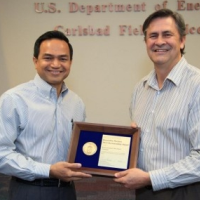
DOE Carlsbad Field Office Site
Operations Director Casey
Gadbury (right) presents Farok
Sharif, president of Nuclear
Waste Partnership,with a
sustainability award
ALLGOV | Jul 24, 2014 | Noel Brinkerhoff


Government officials overseeing the nation’s only underground storage for nuclear waste allowed a nearly $2 million bonus go to a private contractor just days after its shoddy work resulted in a fire that closed the facility.

The Waste Isolation Pilot Plant (WIPP) in New Mexico shut down in February after a salt-hauling truck caught fire in the facility’s underground tunnels.

The fire may have been the result of diesel oil building up on the vehicle’s engine. Shortly after that event, a container with radioactive waste sprung a leak. Investigators are still determining whether the two occurrences were linked.

Regardless, the Department of Energy (DOE) awarded the contractor, Nuclear Waste Partnership (NWP), a $1.9 million bonus for its “excellent” work at WIPP during 2013. Included in the criteria for that bonus is safety and maintenance. The bonus was delivered five days after the truck fire.

Independent watchdogs have been beside themselves over DOE’s decision.

“Efforts to hold individuals or entities accountable remain unclear,” Martin Schneider, chief executive of ExchangeMonitor Publications, wrote in an editorial. “No federal or contractor official has lost their job, been transferred, been moved off the WIPP contract or otherwise held accountable. No leadership has changed at the federal level. No company has lost a contract.”

“It’s become almost a ritual that the contractor gets its bonus no matter what,” Edwin Lyman, senior scientist with the Union of Concerned Scientists’ global security program, told the Albuquerque Journal. “There is so little competition for management of these sites.”

Subsequently, DOE did fine NWP for allowing the fire: It reduced the firm’s potential $8.2 million paycheck for this year by $2 million.

However, the company can get back half that $2 million for good performance or making corrective changes, the Albuquerque Journal reported.

WIPP has been shut down since the fire and is expected to re-open in 2016.

To Learn More:

WIPP Contractor Received $1.9M Bonus after Fire (by Lauren Villagran, Albuquerque Journal)

Thursday, July 24, 2014

MERS may have mutated to airborne agent

Underground Medic | Jul 24, 2014 | Liz Bennett

Particles of the MERS (Middle East Respiratory Syndrome) virus have been found in the air of a barn that had housed an infected camel. The particles contained genetic fragments of the virus on all three days that the air was sampled.

The owner of the barn, a 43 year old male died of MERS in hospital in Jeddah, Saudi Arabia. In searching for the source of the virus the air in the barn was sampled. Sometime later one of the camels he tended was found to have the virus.

This raises issues about how much MERS needs to be in the air before it can be passed from person to person. The camel owner who died is not a good subject to assess this from because he was handling camels, a known vector of the disease, and he could therefore have caught it direct from the camel rather than from sharing air with the beast.

With the World Health Organization recording 701 deaths from MERS (up to June 16th), and with roughly a third of those cases proving fatal MERS going airborne is the last thing we need.

Sustained person to person transmission becomes the reality once the virus no longer needs the vector, in this case camels, to act as the intermediary host.
The findings show the need for “further investigations and measures to prevent possible airborne transmission of this deadly virus,” lead author Esam Azhar, said in a news release from the American Society for Microbiology. Azhar is the head of the Special Infectious Agents Unit at King Fahd Medical Research Center and associate professor of medical virology at King Abdulaziz University in Jeddah, according to the news release.

“This study also underscores the importance of obtaining a detailed clinical history with particular emphasis on any animal exposure for any [MERS] case, especially because recent reports suggest higher risk of [MERS] infections among people working with camels,” he added. (source)
Take Care

Liz

Can Private Drones be Used to Counter “Ag-Gag” Laws in 7 States?

(photo: Will Porter)
ALLGOV | Jul 22, 2014 | Noel Brinkerhoff, Steve Straehley


An investigative journalist has decided that if state laws prevent him from documenting evidence of wrongdoing inside factory farms, he’ll take to the air to see what’s going on.

Using the online fundraising website Kickstarter, journalist Will Potter managed to raise $75,000 to purchase multiple drones for aerial surveillance of large livestock facilities.

Potter told NPR’s The Salt that the move was necessary since seven states have adopted “ag-gag” bills that outlaw the collecting of images inside such operations that reveal neglect or abuse.

“I was primarily motivated by what’s happening outside of those closed doors, but is still invisible and hidden from the public spotlight,” he said. “In particular, I was motivated by seeing these aerial photographs and satellite imagery of farm pollution, of waste lagoons, of sprawling industrial operations.”

Potter says that with the images he gets from the drone, he’ll create a documentary about ag-gag laws and factory farming and publish an e-book.

Industry officials were not pleased to learn of Potter’s drone plans, which some say will be used by animal rights activists to further taint corporate-owned farms. One spokeswoman even took a shot at Potter’s campaign rather than attempt to defend the abuse that often happens on such farms. “It’s even more unfortunate that people contribute to campaigns like this on Kickstarter instead of investing in any of the other myriad of worthy causes—including working to end hunger,” said Emily Meredith of the Animal Agriculture Alliance.

Still others have made veiled threats to shoot down the drones if they’re spotted near agricultural operations. “Those things better not be coming over during duck season because there are hunters out there that might look up and mistake that drone for a duck,” Chuck Jolley, a meat industry veteran, told Harvest Public Media.

Whether Potter will get away with running his Anti-Ag-Gag Air Force is another question. Clemens Kochinke, an attorney who writes the Drone Law blog, says the law is unclear about monitoring agricultural operations and whether Potter’s First Amendment rights might trump other concerns.

Potter isn’t the first animal-rights activist to take to the air. PETA has launched drones to “stalk” hunters suspected of illegal activities.

To Learn More:

Deploying Drones to Get an Overview of Factory Farms (by Peggy Lowe, National Public Radio)

Wednesday, July 23, 2014

The Simple Reason This Country Is So Sick!

iHealthTube.com | Jul 23, 2014

Dr. Peter Glidden explains why nearly all Americans, regardless of diet, lack essential nutrients for optimal health. Find out why this is, and what you can do about getting back on the right track to optimal health!

The Ten Plagues That Are Hitting America Right Now

End of the American Dream | Jul 23, 2014 | Michael Snyder

Why are so many plagues hitting the United States all of a sudden?  Yes, one can always point out bad stuff that is happening somewhere in the country, but right now we are facing a nightmarish combination of crippling drought, devastating wildfires, disastrous viruses, dying crops and superbugs that scientists don’t know how to kill.  And as you will see, we even have a plague of flies down in Mississippi.  So what in the world is going on?  Is this just a case of bad luck, or is something else happening?  At the conclusion of this article, please feel free to tell me what you think.  The following are ten plagues that are hitting America right now…

#1 The Plague Of Flies In The Upper Mississippi River Valley

This is perhaps the least dangerous plague, but it is also one of the most interesting.  Just recently, a plague of flies was so thick in the upper Mississippi River valley that it showed up on radar
The mayflies were detectable on radar around 845 pm and reports in the towns and cities began rolling in of the swarming and piles of mayflies. Numerous videos and pictures were circulating on social media, some of which are posted below as well.

The radar detected the flies about 845 pm, emanating from the river (the source) with echo values similar to that of light-moderate rain (35-40 dBZ). With a general south-to-north wind flow above the surface, the mayflies quickly moved north once in the air. As the flies dispersed moving north-northeast, they also gained altitude with some of the echo being detected as far north as Black River Falls and as high as 2500 feet above ground.

By late evening, mayflies were swarming in La Crosse, La Crescent, Stoddard and points up and down the river. While the emergence of mayflies from their river bottom mud dwelling can occur at various times through the warm season depending on the species, this particular emergence was that of the larger black/brown Bilineata species.
Here is one photo of the flies that was posted by the federal government…


#2 The Chikungunya Virus

As I wrote about the other day, down in Florida health officials have discovered the very first confirmed cases of the chikungunya virus to be transmitted locally.  In other words, it is now being passed to people that have not even traveled out of the country.

An epidemic of the virus has already been declared down in Puerto Rico, and authorities are deeply concerned about the possibility of one up here as well.

Already, cases of the virus have been reported in 30 different states and the total number of cases in the U.S. is more than five times higher than in any other recent year.

If you live in an area that has a lot of mosquitos, you might want to be very, very careful right about now because this is a virus that is exceedingly painful
With illness onset, the person develops high fever, chills, and joint pain, followed in some by a rash on the trunk, limbs and face lasting 3-4 days. Muscle and joint pain last about one week. Joint pain is often severe and in some people lasts longer, up to several months.
#3 The Wildfires Out West

The massive wildfires in Washington, Oregon and western Canada have spread clouds of smoke over vast areas of the northwest United States in recent days.  The following excerpt comes from a recent CNN report
Wildfires spanning almost 170,000 acres are driving hundreds of people from their homes in Washington state and across the border in Canada, officials said.

Washington authorities say the fires surged overnight to 168,713 acres in the state. The flames have encroached on towns.

Janet Pearce of the Washington state Department of Natural Resources said the four fires had not been contained as of Friday morning. An estimated 80 homes were destroyed and cell phone service was knocked out.
#4 The Drought In California

The nightmarish multi-year drought in the state of California just continues to get even worse.

This week it was reported that 81 percent of California is now experiencing “extreme drought” or worse.
Three months ago, that number was just 68 percent.

And we are being told that downtown Los Angeles is now the driest that it has been since rain records began in 1877.

For much, much more on this, please see my recent article entitled “20 Signs The Epic Drought In The Western United States Is Starting To Become Apocalyptic“.

#5 The Virus That Has Killed Millions Of Our Pigs

A horrific pig virus known as porcine epidemic diarrhea came over from China a little over a year ago.

Since then, it has killed about 7 million pigs, and approximately 100,000 more are dying each week.

#6 Citrus Greening

Have you ever heard of citrus greening disease?

Perhaps not, but it has gotten so bad down in Florida that experts are now saying that the entire citrus industry in the state “could be destroyed”
“It’s horrible — it’s a disaster,” says Fred Gmitter, a professor of horticulture science at the University of Florida Citrus Research and Education Center.

It might be time to kiss your OJ goodbye, unless science steps in to save the day.
At least 70% of Florida’s citrus trees are already infected by the disease, known as citrus greening, huanglongbing, or occasionally just with an ominous “it,” as in “It’s here.”

Florida’s citrus crop this year is the lowest it’s been in 30 years, and agricultural authorities have continued to lower their production estimates. Orange-juice prices are up nearly 20% this year alone and will continue to rise. The disease was a major factor in the lime shortage that made the price of a box of Persian limes jump from $18 to $85 last December. Prices could jump higher for oranges. Researchers and growers say that if a cure isn’t found, the entire $9 billion Florida citrus industry could be destroyed.
#7 Bananas Going Extinct?


You bananas are not safe either.

According to CNBC, the TR4 fungus is spreading so rapidly that it could eventually totally wipe out the variety of bananas that we find in our grocery stores today…
Banana lovers take note: The world’s supply of the fruit is under attack from a fungus strain that could wipe out the popular variety that Americans eat.

“It’s a very serious situation,” said Randy Ploetz, a professor of plant pathology at the University of Florida who in 1989 originally discovered a strain of Panama disease, called TR4, that may be growing into a serious threat to U.S. supplies of the fruit and Latin American producers.

“There’s nothing at this point that really keeps the fungus from spreading,” he said in an interview with CNBC.

While there are nearly 1,000 varieties of bananas, the most popular is the Cavendish, which accounts for 45 percent of the fruit’s global crop—and the one Americans mostly find in their supermarkets.
#8 The Number Of Earthquakes Is Increasing

For a long time, scientists tried to deny that the number of earthquakes is increasing.

But now, the USGS is finally admitting that the number of big earthquakes has doubled
If you think there have been more earthquakes than usual this year, you’re right. A new study finds there were more than twice as many big earthquakes in the first quarter of 2014 as compared with the average since 1979.

“We have recently experienced a period that has had one of the highest rates of great earthquakes ever recorded,” said lead study author Tom Parsons, a research geophysicist with the U.S. Geological Survey (USGS) in Menlo Park, California.
Fortunately, most of the earthquakes in the U.S. so far this year have been relatively small or have been in isolated areas.

But they have been popping up in very unusual areas (such as Oklahoma), and as seismic activity along the Ring of Fire continues to increase, it is probably only a matter of time before one of our major cities gets hit with a major tragedy.

#9 Superbugs

Thanks at least in part to the massive overuse of antibiotics, a new generation of superbugs is arising.  Scientists have no way to kill these superbugs, and according to experts they are finding their way “into healthcare facilities nationwide”
Drug-resistant superbug infections have reached near-epidemic levels across U.S. hospitals, with an alarming 500% increase now documented in a study just published in the August issue of Infection Control and Hospital Epidemiology (the journal of the Society for Healthcare Epidemiology of America).

Lead author of the study, Dr. Joshua Thaden, warned “This dangerous bacteria is finding its way into healthcare facilities nationwide… A CRE epidemic is fast approaching… Even this marked increase likely underestimates the true scope of the problem given variations in hospital surveillance practices.”

The study also found that an astonishing 94 percent of CRE infections were caused by healthcare activities or hospital procedures.
#10 Fukushima

The Fukushima nuclear disaster is the gift that just keeps on giving.

Hundreds of tons of radioactive water are being released into the Pacific on a continual basis, and this could potentially affect our oceans and our food chain for generations to come.

But it is a “slow motion disaster” that is already “old news”, so most Americans don’t think about it anymore.  But the truth is that there is a lot of evidence that it should be taken very seriously in this country.  For much more on this, please see this article.

In Japan, of course, things are even worse.

In fact, one Japanese doctor that was working in Tokyo says that radiation sickness is rampant in that city
Since December 2011, I have conducted thyroid ultrasound examinations, thyroid function tests, general blood tests and biochemical tests on about 2000 people, mostly families in the Tokyo metropolitan area expressing concerns on the effects of radiation. I have observed that white blood cells, especially neutrophils, are decreasing among children under the age of 10. There are cases of significant decline in the number of neutrophils in 0-1 year-olds born after the earthquake (<1000). In both cases, conditions tend to improve by moving to Western Japan (Neutrophils 0–>4500). Patients report nosebleed, hair loss, lack of energy, subcutaneous bleeding, visible urinary hemorrhage, skin inflammations, coughs and various other non-specific symptoms.
And this Japanese doctor believes that things are so dire that he says that the entire city of Tokyo should be evacuated…
Residents of Tokyo are unfortunately not in the position to pity the affected regions of Tohoku because they are victims themselves. Time is running short. I took an earlier step forward and evacuated to the west. My fellow doctors of medicine, I am waiting for you here. And to the people in Eastern Japan still hesitating, all my support goes to facilitating and enabling your evacuation, relocation, or a temporary relief in Western Japan.
Just like with Chernobyl, this radioactive material is going to silently make people sick and kill people all over globe for years to come, and most of them will never have any idea what is really happening to them.

So what do you think about all of this?

Please feel free to share your thoughts by posting a comment below…

10 MINUTES TO REMEMBER (Planet Under Pressure)

Last Messages | Jul 23, 2014


Ebola death toll tops 600, spreads to 4 more counties in Liberia – WHO losing fight to contain outbreak


The Extinction Protocol | Jul 19, 2014

AFRICA -  New cases of Ebola virus have been found in four additional counties in Liberia, raising the number of affected counties to seven out of a total of 15. The four counties are located in the west, center and east of Liberia, while the virus has affected mainly western parts of the county. Ebola has spread through several West African countries, including Sierra Leone, Liberia and Guinea, since its latest outbreak in February. The death toll from the virus has surpassed 600 despite efforts by regional and international health experts to contain the epidemic. Guinea is the worst-hit country with more than 500 people losing their lives. Liberia has reported 105 deaths since the outbreak there in May, while 142 have lost their lives in Sierra Leone. There is currently no known cure for Ebola, a form of hemorrhagic fever whose symptoms are diarrhea, vomiting and bleeding. Some people in the affected communities reportedly believe that outsiders are spreading, rather than fighting, the Ebola outbreak. WHO noted on Tuesday that there have been at least 68 new deaths in the region from last week alone, bringing the death toll to 603 since February.

The virus has continued its spread throughout Guinea, Liberia, and Sierra Leone, despite local and international efforts to contain it. Epstein revealed that the main focus in the three countries currently is finding people who have been exposed to the disease, and placing them in a 21-day incubation period to see if they are infected. “It’s probably going to be several months before we are able to get a grip on this epidemic,” the WHO spokesman offered. WHO Director-General Margaret Chan said about mobilizing leaders in West Africa to work together in welcoming medical professionals treating victims: “Sometimes the challenge for us is countries like to do disease control their way. But I think this is one such situation where countries must come together and adopt a similar approach to deal with a very dangerous disease.” The virus, which was first discovered in 1976, is known to have a 90 percent death rate for those infected. “The situation in West Africa should be a wake-up call to recognize that this weakening of this institution on which we all depend is not in anybody’s interest,” Scott Dowell, director of disease detection and emergency response at the U.S. Centers for Disease Control and Prevention, said during a briefing in Washington. “In my view, there’s no way that WHO can respond in a way that we need it to.”

Ebola virus symptoms include a sudden onset of fever, intense weakness, muscle pain, headache and sore throat, which is followed by vomiting, diarrhea, rash, impaired kidney and liver function, and in some cases, both internal and external bleeding, WHO explains. Christian relief organization Samaritan’s Purse, which has sent a medical team to the region to offer help in battling the disease, said last week that it is directing efforts at an Ebola isolation center in Liberia, near the border with Guinea. “This is the largest outbreak of Ebola since it was first discovered in 1976 and it is the largest outbreak in Western Africa, with cases now showing up in national capital cities,” said Ken Isaacs, vice president of programs and government relations for Samaritan’s Purse. “Along with medical treatment, awareness and education are the keys to containing this outbreak.” Samaritan’s Purse President Franklin Graham has added that Ebola is “one of the most deadly diseases in the world, and it must be contained as quickly as possible.” –Press TV  LA Times

Aquifers in Danger: California State Shuts Down 11 Frackers - Reviewing Hundreds More

A pumpjack brings oil to the surface in
the Monterey Shale, California
(Reuters / Lucy Nicholson)
RT | Jul 22, 2014

California is shutting down 11 oil and gas wastewater injection sites and reviewing over 100 others in the state’s drought-ravaged Central Valley as officials fear companies have pumped toxic fracking fluids into needed drinking water aquifers.

The California Division of Oil and Gas and Geothermal Resources issued cease and desist orders on July 7 to seven energy companies, warning that they may be injecting hydraulic fracturing, or fracking, waste fluids into aquifers, which "poses danger to life, health, property, and natural resources,” the state wrote. The orders were confirmed with ProPublica after they were first reported by the Bakersfield Californian.

The demands come at a time of unprecedented drought in the state that has hit California’s top agriculture areas, emptying reservoirs and costing the state $2.2 billion thus far this year. The lack of water has forced the state to use supplemental water supply from underground aquifers, the University of California-Davis reported in a study released last week.

Unfortunately, the state years ago deemed at least 100 aquifers to be useless for drinking and farming given the water’s poor quality or location deep underground. The state exempted them from environmental guidelines, allowing energy companies to pollute them. Not all aquifers were exempted; protected and unprotected aquifers are overseen by a patchwork of regulations. But officials say the cease and desist orders issued by California regard seven injection wells that are likely leaving toxic waste into freshwater aquifers not exempted by the state.

"The aquifers in question with respect to the orders that have been issued are not exempt," said Ed Wilson, a spokesperson for the California Department of Conservation, told ProPublica.

Over 700,000 injection wells across the US are poorly regulated and are often polluting underground water supplies supposedly protected by federal law, ProPublica reported in 2012, adding that the US Environmental Protection Agency exempted more than 1,000 drinking water aquifers, many of them in California, from all pollution protection.

Now these aquifers are needed during fierce drought conditions. The state and the EPA worked together in 1981, often haphazardly, to the point where it is difficult today to surmise which bodies of water are supposed to be protected, and by which parts of the applicable laws.

California officials say the water will be tested and monitored at the pertinent injection wells. They say to date, none of the regulated aquifers have been contaminated.

"We do not have any direct evidence any drinking water has been affected," said Steve Bohlen, the state oil and gas supervisor, in a statement to ProPublica.

State officials said new orders to study fracking impacts first alerted them to the potential problems posed by injection sites. The state has been criticized for its waste disposal program, though it is operated under EPA guidelines.

Experts say the state should have known, based on California’s precarious water supply, that aquifers could become a needed source of water as the climate changes and technology helps reduce barriers of access to the water while aiding its treatment for contamination.

The EPA conducted a review of California’s injection well operations in 2011, finding severe enforcement, testing, and oversight problems that required immediate improvement. The feds warned at the time that failing to address these shortcomings could lead to a revocation of the state’s authority.

The exemptions and lack of protection of vital water supply are “especially disturbing,” National Resources Defense Council attorney Damon Nagami said, in a state that has long understood its own water constraints.

"Our drinking water sources must be protected and preserved for the precious resources they are, not sacrificed as a garbage dump for the oil and gas industry."

Three years after the EPA report, California has not finished its review of the injection well program, state officials said.

To unleash oil or natural gas, fracking requires blasting large volumes of highly pressurized water, sand, and other chemicals into layers of rock.

Besides groundwater contamination, fracking has been linked with an uptick in earthquakes, exacerbation of drought conditions, and a host of health concerns for humans and the local environment.