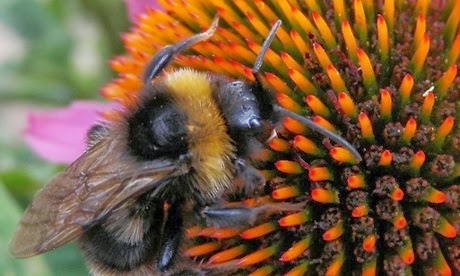
Showing posts with label Bumble Bees. Show all posts

Thursday, April 3, 2014

Half of European bumblebees in decline, quarter face extinction – study

Reuters / Stephen Ausmus
RT | Apr 2, 2014

Almost one-quarter of European crops’ vital pollinators – bumblebees – could die out in the coming years, as half of the species are declining, a new study says. Citing human factor and climate change, it warns of “serious implications” for agriculture.

A preview of the recent European Commission-funded study, published on the website of the International Union for Conservation of Nature (IUCN) on Wednesday, says it has some “bad news” for Europe’s bumblebees.

As much as 46 percent of the 68 bumblebee species living in Europe have a declining population and just 13 percent are increasing in numbers, the study shows. According to IUCN, 24 percent of those species are “threatened with extinction.”

The study, which contributes to the European Red List of pollinators and is part of the Status and Trends of European Pollinators (STEP) project, stresses that three of the five “most important insect pollinators of European crops” are bumblebee species.

Bumblebees have for thousands of years played a “critical role” in agriculture as they help crops reproduce by transferring pollen from plant to plant. However, as agriculture and urban development have intensified in recent years and cultivated land has been changed, bumblebees have been hit by the loss of habitat and the loss of their preferred forage, as well as pollution and insecticides.

The population of critically endangered Bombus cullumanus, for example, has declined by more than 80 percent over the last decade alone, according to the study. Once widespread in Europe, the so-called Cullum’s Bumblebee now survives only “in a few scattered locations,” much due to the mass removing of its favorite clovers from farming practices.

A beef-up in agriculture has also been blamed by the study’s authors for the shrinking population of the endangered Bombus fragrans (Steppe Bumblebee), whose native habitat is being “destroyed” in Ukraine and parts of Russia.

Increasing temperatures and long periods of drought brought about by climate change are also responsible for “major changes” in the insects’ habitat. Those species living in Arctic and sub-Arctic regions, like the Scandinavian tundra and Russia’s extreme north, are vulnerable to a dramatic decline, the study concludes.

‘22 billion euro a year’  

Scientists have been “very concerned” with the findings of the study, Ana Nieto, European biodiversity officer of IUCN and the study’s coordinator, said, adding that “such a high proportion of threatened bumblebees can have serious implications for our food production.”

According to Simon Potts, coordinator of STEP, this shows an increasing threat to Europe’s “natural capital,” an essential part of which is “the contribution of bumblebees to food security and the maintenance of wider plant biodiversity.”

The study itself offers an even more striking assessment of this “capital.”

Together with other pollinators, bumblebees contribute “more than 22 billion euros [over US$30 billion] to European agriculture per year,” according to IUCN.

The EU’s top environment official, Janez Potocnik, said the EU has already banned or restricted the use of certain pesticides dangerous for pollinators, but their efforts “clearly need to be scaled up.”

Potocnik believes the solution lies in “mainstreaming of biodiversity into other policies” and in raising awareness about the benefits that bumblebees bring.

According to Nieto, the negative trends can be reversed by “protecting bumblebee species and habitats, restoring degraded ecosystems and promoting biodiversity-friendly agricultural practice.”

More precisely, such measures may include “increasing the margins and buffer strips around agricultural fields that are rich in flowers and wildlife and the preservation of grasslands.”

Calls for awareness of bumblebees’ plight come as the EU strategy to halt biodiversity loss remains under review. The previously approved plan, set by EU leaders in March 2010, must be “fully implemented,” IUCN has stressed.

Reuters / Vasily Fedosenko

Wednesday, January 22, 2014

Pesticides 'making bees smaller'

Bumblebees could be shrinking because of exposure
to a widely-used pesticide, a study suggests.
Photograph: Nick Ansell/PA
Pesticides 'making bees smaller'
Jan 20, 2014 | Guardian | Press Association

Bumblebees exposed to a widely-used pesticide produced workers with lower body mass, scientists find

Bumblebees could be shrinking because of exposure to a widely-used pesticide, a study suggests.

Experts fear smaller bees will be less effective at foraging for nectar and carrying out their vital task of distributing pollen.

Scientists in the UK conducted laboratory tests which showed how a pyrethroid pesticide stunted the growth of worker bumblebee larvae, causing them to hatch out reduced in size.

Gemma Baron, one of the researchers from the School of Biological Sciences at Royal Holloway, University of London, said: "We already know that larger bumblebees are more effective at foraging.

"Our result, revealing that this pesticide causes bees to hatch out at a smaller size, is of concern as the size of workers produced in the field is likely to be a key component of colony success, with smaller bees being less efficient at collecting nectar and pollen from flowers."

Pyrethroid pesticides are commonly used on flowering crops to prevent insect damage.

The study, the first to examine the pesticides' impact across the entire lifecycle of bumblebees, tracked the growth of bee colonies over a four month period.

Researchers exposed half the bees to a pyrethroid while monitoring the size of the colonies as well as weighing individual insects on micro-scales.

They found that worker bees from colonies affected by the pesticides over a prolonged period grew less and were significantly smaller than unexposed bees.

Findings from the study, funded by the Natural Environment Research Council (Nerc), appear in the Journal of Applied Ecology.

Professor Mark Brown, who led the Royal Holloway group, said: "Bumblebees are essential to our food chain so it's critical we understand how wild bees might be impacted by the chemicals we are putting into the environment.

"We know we have to protect plants from insect damage but we need to find a balance and ensure we are not harming our bees in the process."

Currently a Europe-wide moratorium on the use of three neonicotinoid pesticides is in force because of their alleged harmful effect on bees.

As a result, the use of other types of pesticide, including pyrethroids, is likely to increase, say the researchers.

Dr Nigel Raine, another member of the Royal Holloway team who will be speaking at this week's national Bee Health Conference in London, said: "Our work provides a significant step forward in understanding the detrimental impact of pesticides other than neonicotinoids on wild bees.

"Further studies using colonies placed in the field are essential to understand the full impacts, and conducting such studies needs to be a priority for scientists and governments."

The scientists sprayed the pesticide on the bees' pollen feed at the concentration recommended for oilseed rape.

Colony growth and reproductive output were monitored for up to 14 weeks.

Tuesday, July 23, 2013

'Beemageddon' delayed: Bumblebee reemergence puzzles scientists

AFP Photo / Joel Saget
'Beemageddon' delayed: Bumblebee reemergence puzzles scientists
July 23, 2013 | RT

A disappearing North American bumblebee species has reemerged in Washington state, stunning scientists and conservationists who long feared that “Beemageddon” would cause the collapse of the agriculture industry.

The Bombus occidentalis, also known as the Western Bumble Bee, has disappeared from half of its natural range, but was recently spotted among the flowers of a park north of Seattle, Reuters reports.

Multiple sightings of the vanishing bee, including several queens, have instilled new hope that it could make a comeback in the Pacific Northwest.

“It gives us hope that we can do some conservation work, and perhaps the species has a chance at repopulating its range,” Rich Hatfield, a biologist at the Xerces Society for Invertebrate Conservation, told Reuters, noting that the sightings are “a pretty big deal.”
 
The Western Bumble Bee vanished from parts of the US more than a decade ago. Since their disappearance, the first sighting in Washington state occurred last year, when an insect enthusiast found such a bee in her garden. Earlier this month, Will Peterman, a 42-year-old freelance writer and photographer, captured photos of the Bombus occidentalis searching for nectar in a park in Brier.

Peterman returned to the park with a group of entomologists on Sunday, and took additional photos of some of the queen bees. He described the scientists’ mood as “almost giddy” and “optimistic”.
 
Scientists have attributed bumblebee declines to parasites, pesticides and habit fragmentation. Hatfield believes a deadly fungus might have contributed to the decline of the Bombus occidentalis. He now wonders whether the species has developed a resistance to this fungus, thereby repopulating the Pacific Northwest. 

Bees are crucial for the agriculture industry, since they pollinate crops such as tomatoes, cranberries, almonds, apples, zucchinis, avocados and plums. More than 100 types of US crops, valued at more than $200 billion each year, rely on bees to pollinate them.

A recent University of California study conducted by Berry J. Brosi, an assistant professor, and Heather M. Briggs, a graduate student, also found that the loss of bees could threaten certain types of plants and flower species that rely on pollination to produce their seeds.

The honey bee population has taken a particularly hard toll. The US is currently home to about 2.5 million honey bee colonies, which is a drastic decrease from the 6 million that existed in 1947 and the 3 million that existed in 1990.

Bumblebees have also faced dwindling populations, and an estimated 50,000 bees died in an Oregon parking lot in June, just days before National Pollinator Week.

“Bees across the country are not in as good a shape as last year,” Eric Mussen, a University of California bee specialist, told the Christian Science Monitor.  But with the reemergence of the Bombus occidentalis in Washington state, “Beemageddon” might be delayed.

Sunday, August 26, 2012

Toxic Pesticides and the Flight of The Bumblebee: Are We Poisoning Our Future?

Toxic Pesticides and the Flight of The Bumblebee: Are We Poisoning Our Future?
Aug 26, 2012 | Colin Todhunter

Have you heard the buzz lately? Billions of bumblebees have been dying off, and, as a result, the entire global food chain may be in danger. Along with other insects, such as moths and hoverflies, bees pollinate around a third of the crops grown worldwide.

Photo source Wikipedia
The humble bee is a much under-appreciated creature. In fact, life as we know it depends on it. Bees pollinate wild plants and agricultural crops, including some 90 per cent of the world’s commercial plants. Most fruits, vegetables and nuts, including okra, tomatoes, sunflowers, cucumbers, cashew, onion, cabbage, rapeseed, almonds, citrus fruits and cherries are all pollinated by bees, and coffee, soya beans and cotton are dependent on them to increase yields. Bees are at the forefront of a food chain that also sustains wild birds and animals.

As with other crucial pollinators, bees have been in serious decline around the world for the past few decades. Sydney Cameron, an entomologist at the University of Illinois, led a team on a three-year study of eight species of bumblebees in the US. The findings showed that the relative abundance of four of the sampled species had declined by up to 96 per cent and that their geographic ranges had contracted by 23 to 87 per cent, some within the past two decades. In the US, 50 to 90 per cent of commercial bee colonies are affected by ‘Colony Collapse Disorder’. The decline is however not restricted to the US. It’s a major global issue.

In the UK, for instance, three of the 25 British species of bumblebee are already extinct, and half of the remainder has shown serious declines, often up to 70 per cent, since around the 1970s. Bee populations have also been affected in the mainland Europe, China and India.

Reasons for the decline of bees may be many, including parasites, viral and bacterial infections, changes to habitat, pollution, poor nutrition stemming from intensive farming methods and even mobile phone frequencies. However, one of the causes points to the use of neonicotinoids, a nicotine-based pesticide that has been banned in France, Germany, Portugal, Greece, Italy and Slovenia.

In 2010, writer and activist Tom Philpott wrote that the US Environmental Protection Agency (EPA) allowed the widespread use of clothianidin, a neonicotinoid manufactured by the chemical and pharmaceutical company Bayer, despite warnings from the EPA’s own scientists.

Philpott’s evidence was based on a leaked internal EPA memo that revealed clothianidin has serious health impacts on bees, which may be directly related to their disappearance. The memo reported that studies show clothianidin is highly toxic and that information from standard tests and field studies, alongside incident reports involving similar insecticides, suggests the potential for long-term toxic risk to honeybees and other beneficial insects. In December, beekeepers and environmentalists in the US asked the EPA to remove its approval of the pesticide.

order family medicine herb seed pack
Ad
Nevertheless, the EPA has allowed the widespread use of the pesticide on corn, wheat and other staple food products. Meanwhile, Bayer raked in $262 million in 2009 from its sales of neonicotinoids to farmers.

Bayer continues to export or manufacture its pesticides across the world, including in India. In fact, imidacloprid, another neonicotinoid, is one of India’s highest selling pesticides.

Dr Parthiba Basu from the University of Calcutta argues that India is also experiencing a decline. His research team’s findings show that the yields of pollinator-independent crops have continued to increase, whereas pollinator-dependent crops have levelled off. In an attempt to identify an underlying cause for the pollinator decline, the team is comparing conventional agriculture with ecological farming. Basu states there is an obvious indication that within the ecological farming setting (where harmful pesticides are not used), there is pollinator abundance.

He added that if the team’s findings were extrapolated, this would offer a clear indication that India was facing a decline in natural pollinators, as ecological farming was only practiced on about 10-20 per cent of the country’s arable land. There are serious implications. Unlike those with access to a varied diet, Basu says there are certain vegetable crops that many people living near the poverty threshold rely on. If there is a pollination crisis, Basu suggests nutritional security could be affected.

In India, wild honey collection in the Kutch region of Gujarat in 2010 fell to 50 tonnes from the usual 300 tonnes in previous years because of the fall in the number of honey bees. The yield of certain native crops like date palms, lemon, papaya and kesar mangoes has also decreased. In Malda, West Bengal, mango honey was once good business, but farmers say bees are now avoiding mango trees.

There’s still a lot we don’t know about the massive bee die-offs. But one thing we do know is that bees are in trouble — by implication, we are too.

Given the revelations concerning the EPA in the US with regard to neonicotinoids, another thing we know is that we should no longer leave our food chain or ecology in the hands of the big chemical and pharmaceutical companies — nor should we rely on the regulating and policy bodies that are too often seen to be in their pockets.

Colin Todhunter : Originally from the northwest of England, Colin Todhunter has spent many years in India. He has written extensively for the Deccan Herald (the Bangalore-based broadsheet), New Indian Express and Morning Star (Britain). His articles have also appeared in various other newspapers, journals and books. His East by Northwest website is at: http://colintodhunter.blogspot.com

Global Research Articles by Colin Todhunter